









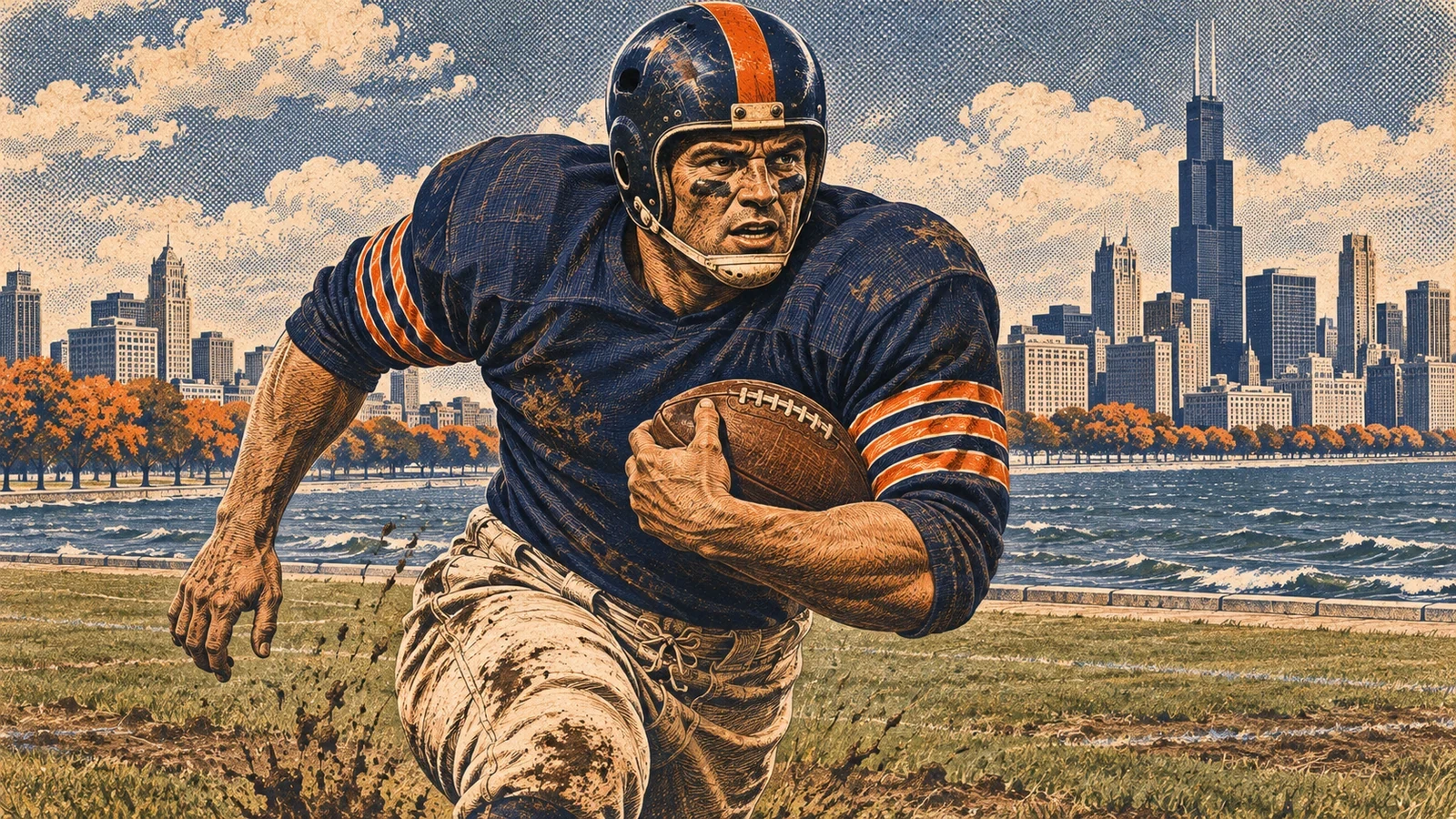

Any honest Bears draft ends up with somebody great sitting on the bench at middle linebacker. Dick Butkus, Mike Singletary and Brian Urlacher solved different versions of the same problem. We start with a running back because his work gives almost any Chicago offense a chance, then sort the defenders by the demands of their own eras and the assignments they could handle on this roster. The Bears who played before the Super Bowl belong in the same discussion.
1. Walter Payton, running back
Payton rushed for 16,726 yards, but the fifth or sixth yard of a difficult carry makes a better introduction than the total. He could turn a blocked three-yard run into a useful second down, then stay in to block for his quarterback. That gives every quarterback in Chicago history a little more space and a better down to work with.
2. Dick Butkus, middle linebacker
Butkus could take on a blocker, find the ball and make the runner worry about losing possession as well as losing yardage. A roster that measures him by championships would be measuring the teams around him. We would take him to diagnose the first series before the defense knows what its opponent does best.
3. Gale Sayers, running back and returner
The six touchdowns in one game against San Francisco in 1965 came by run, reception and punt return. A defense that changed its personnel to stop one of those threats still had two others to handle. His injuries make the career comparison with Payton straightforward. For a single afternoon, the margin shrinks considerably.
4. Sid Luckman, quarterback
The T formation gave Chicago a way to conceal which man had the ball. Luckman made the deception matter by punishing defenders who guessed run and took their eyes off a receiver. He gets our starting job for his dominance against the defenses of his time. Passing totals alone would put most of that achievement out of view.
5. Mike Singletary, middle linebacker
The 1985 defense is remembered for sending people. Singletary’s job was to keep those moving parts pointed toward the right gap before the ball moved. If we were transplanting the 46 defense whole, he would be the first linebacker selected. Butkus gets the narrow edge in a draft that begins without a predetermined front.
6. Dan Hampton, defensive lineman
Hampton makes a four-man line unusually difficult to set protections against. He could move outside or work over a guard while keeping enough power to hold up against the run. Put Richard Dent beside him and an offense’s best tackle cannot solve both problems on his own.
7. Bronko Nagurski, fullback and tackle
A modern position label does poor justice to Nagurski. Chicago could use the same enormous athlete to clear the path as a blocker, run through a small opening or play on the line. His place on the board is a judgment about how thoroughly a player could dominate the football available to him.
What the modern defense changes
Urlacher is the linebacker we would choose against a team throwing deep down the middle from three-wide personnel. He could run backward to protect the seam and still pursue a checkdown. Charles Tillman gives that package its outside specialist, a corner dangerous enough at stripping the ball that an opponent has to coach its receivers differently. They can both start in a passing package even when Butkus gets the first pick.
An all-time Bears draft roster
Offensive selections QB Sid Luckman, RB Walter Payton, WRs Harlon Hill and Brandon Marshall, TE Mike Ditka. Plan a second package with Gale Sayers outside Payton. Jimbo Covert and Olin Kreutz lead the protection.
Defensive selections Use Richard Dent and Doug Atkins outside with Dan Hampton and Steve McMichael inside. Start Dick Butkus in the middle. Bring Brian Urlacher into the passing package. Charles Tillman and Gary Fencik anchor the secondary.
Build a 17-0 team in FSN All-Timers
Follow Chicago Bears coverage on FSN.
Explore all 32 franchise draft boards and FSN’s greatest NFL teams.