













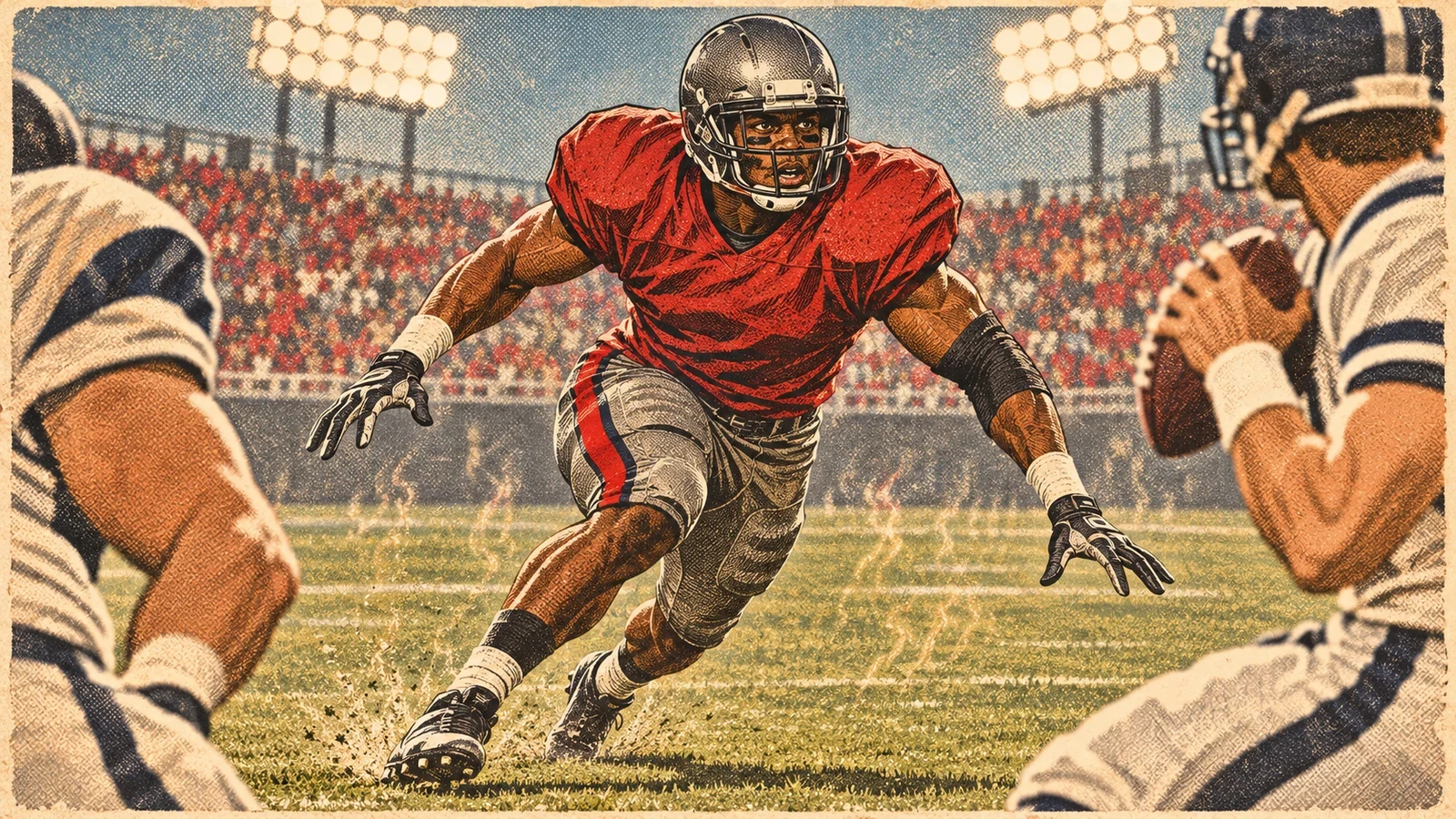
A coverage diagram can tell a middle linebacker where to run. It cannot make a guard block Warren Sapp, make a ball carrier elude Derrick Brooks in space, or make John Lynch arrive a step late. Tampa Bay’s best defensive players are the reason a familiar coverage became a franchise signature. Our board counts only Buccaneers work and recognizes the older foundation laid by Lee Roy Selmon alongside the two championship generations.
1. Derrick Brooks, linebacker
Brooks could pursue to the sideline without giving away an easy throw behind him. That made a short pass to a running back feel like a safe offensive choice right up until the tackle. His interception return for a touchdown in Super Bowl XXXVII is the scoring example. The quieter achievement was limiting a great many routine completions to routine gains.
2. Lee Roy Selmon, defensive end
The early Buccaneers had few ways to create favorable situations for a pass rusher. Selmon still forced offenses to change their protection and helped Tampa Bay reach the NFC championship game after the 1979 season. We rank him second because his impact survived circumstances far less favorable than those enjoyed by the later great fronts.
3. Warren Sapp, defensive tackle
Sapp was the pressure behind the coverage. When he penetrated from the three-technique, the quarterback had to make his decision before the route cleared the underneath linebacker. Put him beside Selmon and help can reach only one in time. That is our most important pair on either line.
4. Rondé Barber, cornerback
Barber could play outside, blitz from the slot and diagnose a throw into the short zone. His long interception return to close the NFC championship game in Philadelphia showed what happens when he arrives at the route first. Against a modern offense, he is the defensive back we would move around most.
5. Mike Evans, wide receiver
Evans began his NFL career with eleven consecutive 1,000-yard seasons, all in Tampa Bay. His body control makes a covered outside route a plausible throw, a particularly useful quality when several different quarterbacks must run the offense over a long career. He gets the first receiving spot before we choose a quarterback.
6. John Lynch, safety
The celebrated hits were the outcome of a less visible skill: taking an angle that let him arrive when the receiver did. He could bring another body into the run front while leaving Tampa Bay’s corners in their preferred coverage. Give him a reliable deep partner and the quarterback must account for his presence closer to the ball.
7. Paul Gruber, left tackle
Gruber played his entire career for Tampa Bay and supplied a stable blind side through seasons with little national attention. On a roster with an exceptional defense, avoiding a strip-sack is often as valuable as creating an explosive pass. He gets the first tackle spot, letting Tristan Wirfs play on the right where he won his first championship.
How much of Brady’s career belongs to Tampa Bay?
Only his three Buccaneers seasons enter our decision. They still include a championship, a Super Bowl MVP and a subsequent 5,316-yard passing season. That is enough to start him in an offense with Evans and Chris Godwin outside and Mike Alstott available in short yardage. James Wilder is our primary back for the combined rushing and receiving work. Warrick Dunn makes the best alternative when the offense wants speed in space.
An all-time Buccaneers draft roster
Offensive selections QB Tom Brady, RB James Wilder, WRs Mike Evans and Chris Godwin, TE Jimmie Giles. Paul Gruber and Tristan Wirfs take the tackle jobs. Mike Alstott gives the goal-line unit an extra back.
Defensive selections Lee Roy Selmon and Simeon Rice set the edges, Warren Sapp and Gerald McCoy work inside, Derrick Brooks and Lavonte David play linebacker. Rondé Barber and Donnie Abraham start at corner, with John Lynch at safety.
Build a 17-0 team in FSN All-Timers
Follow Tampa Bay Buccaneers coverage on FSN.
Explore all 32 franchise draft boards and FSN’s greatest NFL teams.