
















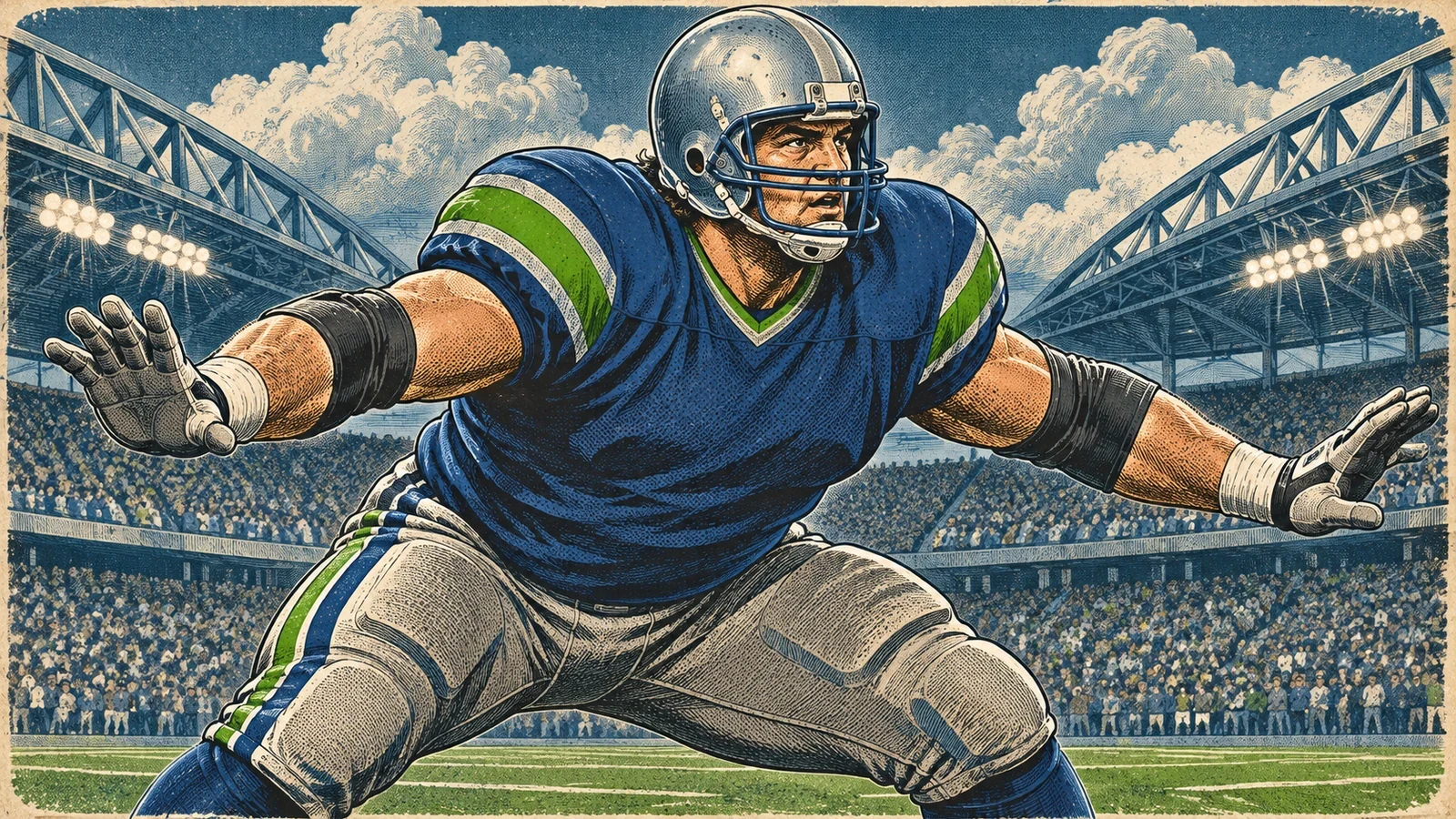

Seattle can start the Legion of Boom almost intact or build an offense around a stretch run behind Walter Jones and Steve Hutchinson. The choice between the units is a false economy in an all-time draft: a great left tackle can keep a roster competitive against the very sort of defense Seattle would like to assemble. Our ranking gives Seattle production the weight, balancing an individual peak with the years a player held an essential job.
1. Walter Jones, left tackle
Jones could prevent an elite pass rusher from reaching the quarterback without help, then move a defender bodily on an outside run. Shaun Alexander’s MVP offense leaned heavily on the left side for a reason. The ability to call a play the defense expects and execute it anyway earns Jones the first pick.
2. Steve Largent, wide receiver
Largent retired with 100 regular-season touchdown catches. He built that total with route control and reliable hands in an era that offered receivers fewer protections. An all-time offense needs somebody who can separate on an intermediate route without the play caller manufacturing an easy release. Largent is that receiver.
3. Cortez Kennedy, defensive tackle
Kennedy won Defensive Player of the Year in 1992 on a 2–14 team. His individual work is unusually easy to separate from the record around it. Put him over a guard and he can wreck a first-down run or squeeze the pocket from inside, especially important if the corners want the pass out before their leverage changes.
4. Russell Wilson, quarterback
Seattle’s championship-era offense could build the run first without surrendering its chance at an explosive pass. Wilson’s deep-ball touch and ability to keep the play alive outside made a defender hesitate before abandoning the receiver. Those Seattle skills are the reason for his place here, independent of anything that happened after he left.
5. Bobby Wagner, linebacker
The Legion of Boom’s coverage attracted the attention. Wagner’s job was to keep the offense from collecting an easy six yards underneath it. He could read the run, tackle in space and protect the middle while the corners stayed physical outside. He is our choice to hold the defense together across different opponents.
6. Earl Thomas, safety
Thomas made a large area of deep field playable by one man. That gave Seattle permission to bring another safety nearer the line and let its corners challenge routes outside. The test is what happens if we take him away: several famous teammates have to start the same snap from a more conservative position.
7. Richard Sherman, cornerback
Sherman made the boundary throw look temptingly familiar, then used length and anticipation to close the window. A defense could trust him with that outside assignment and use Thomas to help elsewhere. He gets the final core spot just ahead of Kenny Easley, whose own peak stands up to any safety’s in franchise history.
Which version of Seattle gets to run the ball?
Use Alexander when the line is built around Jones and Hutchinson: let the blocks develop, then exploit the seam they create. Use Marshawn Lynch when the offense expects a defender to arrive at or behind the line and needs the back to turn contact into an advantage. Their cases answer different questions. Against a front we expect to overpower, we start Alexander. Facing the 2000 Ravens for one afternoon, we would lean toward Lynch.
An all-time Seahawks draft roster
Offensive selections QB Russell Wilson, RB Shaun Alexander, WRs Steve Largent and Doug Baldwin, TE Zach Miller. Start Walter Jones and Steve Hutchinson on the left. Marshawn Lynch enters to close a physical game.
Defensive selections Cortez Kennedy inside, Jacob Green on the edge and Bobby Wagner in the middle. Richard Sherman and Dave Brown at corner, Earl Thomas and Kenny Easley at safety. Kam Chancellor adds the heavier matchup package.
Build a 17-0 team in FSN All-Timers
Follow Seattle Seahawks coverage on FSN.
Explore all 32 franchise draft boards and FSN’s greatest NFL teams.