














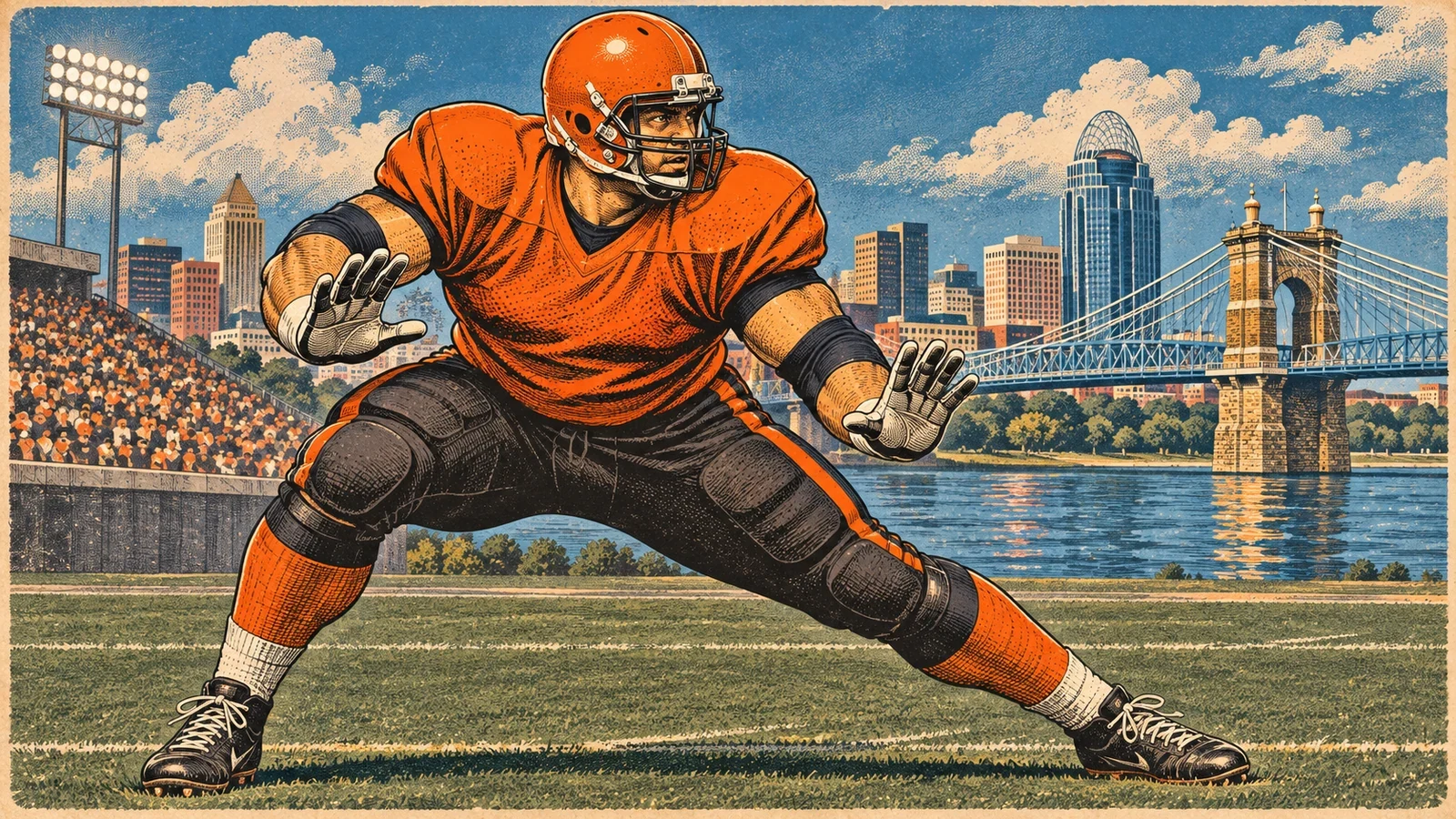

Ask which Cincinnati quarterback should start and four different decades will put up a hand. Ask who should protect his blind side and the conversation is much shorter. Anthony Muñoz is our first Bengal because his selection improves every plausible version of this offense. After him, the distinctions come down to peak performance against contemporaries, length of service in Cincinnati and how many ways a player could force a defense to change its call.
1. Anthony Muñoz, left tackle
Muñoz combined the feet to stay in front of a speed rusher with the strength to move his man when the play demanded it. He played in both of Cincinnati’s first two Super Bowls, protecting different quarterbacks in different offenses. Draft him and the tight end can run a route on the opening snap without first checking who is lined up outside.
2. Ken Anderson, quarterback
Anderson passed for 32,838 yards as a Bengal and led the 1981 team to the franchise’s first Super Bowl. Accuracy let him get a receiver the ball in stride on throws other quarterbacks treated as modest gains. That is the quality we want with a full complement of Cincinnati receivers able to create after the catch.
3. Ken Riley, cornerback
Riley intercepted 65 regular-season passes in a career spent entirely in Cincinnati. It takes opportunity to accumulate that number, but it also takes extraordinarily consistent positioning when offenses have years of film on the same corner. He is our first defender, especially against a quarterback who wants to throw an early route to establish a rhythm.
4. Chad Johnson, wide receiver
Johnson made 751 catches for Cincinnati. Before any celebration came the craft: change the pace of the release, force the corner to turn his hips and break across the defender’s leverage. That ability to get open on a route the opponent expected is why he gets the first outside receiving spot.
5. Boomer Esiason, quarterback
The left-handed release changes the landmarks for a defense reacting to play-action. In the 1988 MVP season, Esiason made the run game and the hurry-up work together, often attacking before an opponent could get new personnel on the field. Give him the Ickey Woods and James Brooks backfield and he has a particularly strong case to start.
6. Geno Atkins, defensive tackle
Atkins could shoot the space between guard and center with enough force to turn the quarterback off his spot. Even when the edge rusher gets credited for the sack, the inside pressure has taken away the natural escape. Cincinnati needs that skill behind its collection of celebrated quarterbacks and receivers.
7. Ja’Marr Chase, wide receiver
Chase’s 2024 receiving triple crown offers a clean snapshot of his peak. He could turn a short completion into an explosive play or draw safety help that made a teammate’s catch routine. His existing timing with Joe Burrow is the strongest argument for choosing a contemporary quarterback-receiver pair instead of our mixed-era starting combination.
Anderson or Burrow when the pocket gets tight?
Burrow is our choice for a spread offense asking its quarterback to solve pressure with quick throws. Anderson gets the nod for this lineup’s rhythm passing and under-center run threat. A.J. Green is the first receiver off the bench. Corey Dillon’s 8,061 Cincinnati rushing yards make him the natural early-down back, while James Brooks gives either quarterback a particularly good answer to a blitz.
An all-time Bengals draft roster
Offensive selections QB Ken Anderson, RB Corey Dillon, WRs Chad Johnson and Ja’Marr Chase, TE Bob Trumpy. Anthony Muñoz anchors the left edge, with Max Montoya at guard. Use A.J. Green when a third receiver enters.
Defensive selections Geno Atkins works inside with Tim Krumrie. Carlos Dunlap threatens the edge. Reggie Williams at linebacker, Ken Riley and Lemar Parrish at corner, and David Fulcher at safety give the back end both range and size.
Build a 17-0 team in FSN All-Timers
Follow Cincinnati Bengals coverage on FSN.
Explore all 32 franchise draft boards and FSN’s greatest NFL teams.