














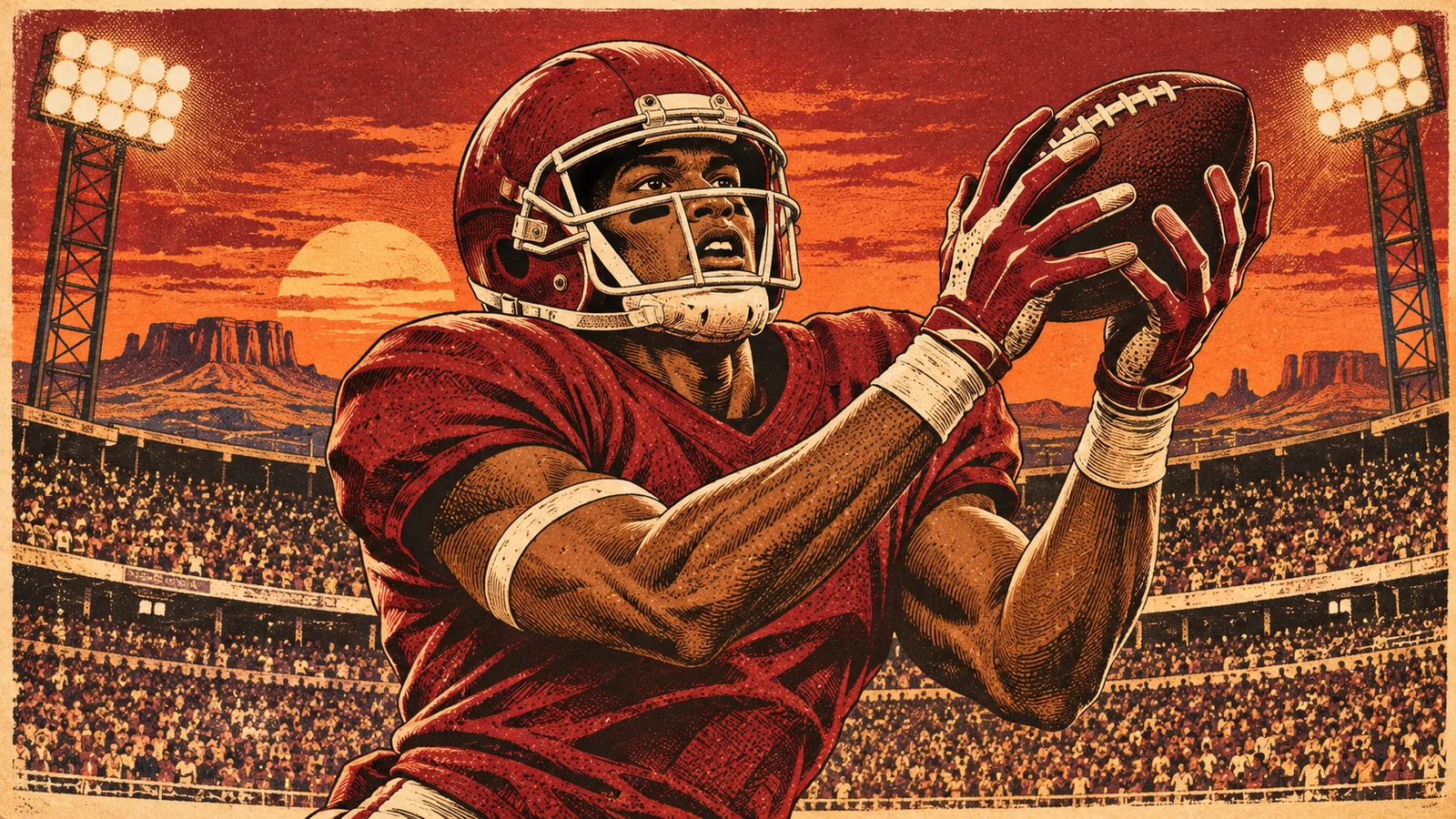

A ranking that starts when the team arrived in Arizona loses a championship backfield in Chicago and an extraordinary offensive line in St. Louis. A ranking that simply counts championships misses the receiver who came within a few minutes of delivering one in Arizona. Our board follows the franchise through all three cities. We give sustained excellence with the Cardinals an edge, then ask which assignments only the very best candidates could handle.
1. Larry Fitzgerald, wide receiver
The 2008 postseason is the argument in miniature. Fitzgerald gained 546 receiving yards and scored seven touchdowns in four games. Opponents knew where Kurt Warner wanted to throw, yet Fitzgerald could climb over coverage on the boundary and turn a short throw through the middle into a race. His later work in the slot extended a career that had begun as an outside specialist.
2. Larry Wilson, safety
Wilson made it dangerous to assume the deepest defender would stay deep. St. Louis could send him toward the quarterback from a position normally reserved for the last line of defense. His 52 career interceptions show the other half of the bargain: sending Wilson and dropping him back were both credible calls.
3. Dan Dierdorf, tackle
The enduring St. Louis advantage was time. Dierdorf could protect the right edge long enough for Jim Hart to look past his first receiver. In a lineup featuring Fitzgerald and a genuine vertical threat across from him, the tackle who buys that extra beat changes which routes are available.
4. Aeneas Williams, cornerback
Williams spent a great deal of his Arizona career playing for teams that could offer precious little margin for an error. He could still take the dangerous outside assignment. His two interceptions in the Cardinals’ playoff win at Dallas after the 1998 season are a reminder that the secondary could win an important game before the Warner era.
5. Charley Trippi, back and returner
In Chicago’s 1947 championship win, Trippi scored on a run and a punt return. A roster with tight position limits cannot credit the same man twice, but a coach can hand him the ball in more than one phase. That combination makes him the first of the old Chicago backs we would take.
6. Larry Centers, fullback
The title on the depth chart is misleading. Centers caught 101 passes in 1995, a receiving workload for a player defenses had to locate in the backfield. He gives a quarterback an answer when the outside receivers are covered and the rush has won. That specific role earns him a spot in an unusually strong group of Cardinals backs.
7. Roger Wehrli, cornerback
Wehrli is the natural partner for Williams. He could follow a route rather than needing the defense to shelter him in a short zone, freeing Wilson to move before the snap. St. Louis’ best players do something similar on both sides of the ball: give the quarterback or coordinator a little more time and freedom.
The hardest cut is at quarterback
Warner gets our start for the offense that reached Super Bowl XLIII. Hart has the stronger Cardinals longevity case and would recognize the protection in front of him immediately. Patrick Peterson has a similar argument at corner. A return-heavy roster could reasonably take him over Wehrli. Our first priority is coverage behind a roaming safety.
An all-time Cardinals draft roster
Offensive selections Kurt Warner leads the offense with Charley Trippi and Larry Centers in the backfield. Larry Fitzgerald and Roy Green play receiver, with Jackie Smith at tight end. Start the protection with Dan Dierdorf, Conrad Dobler and Tom Banks.
Defensive selections Pair Chandler Jones and Calais Campbell up front. Put Larry Wilson behind Aeneas Williams and Roger Wehrli, with Larry Stallings at linebacker. Patrick Peterson handles returns.
Build a 17-0 team in FSN All-Timers
Follow Arizona Cardinals coverage on FSN.
Explore all 32 franchise draft boards and FSN’s greatest NFL teams.