















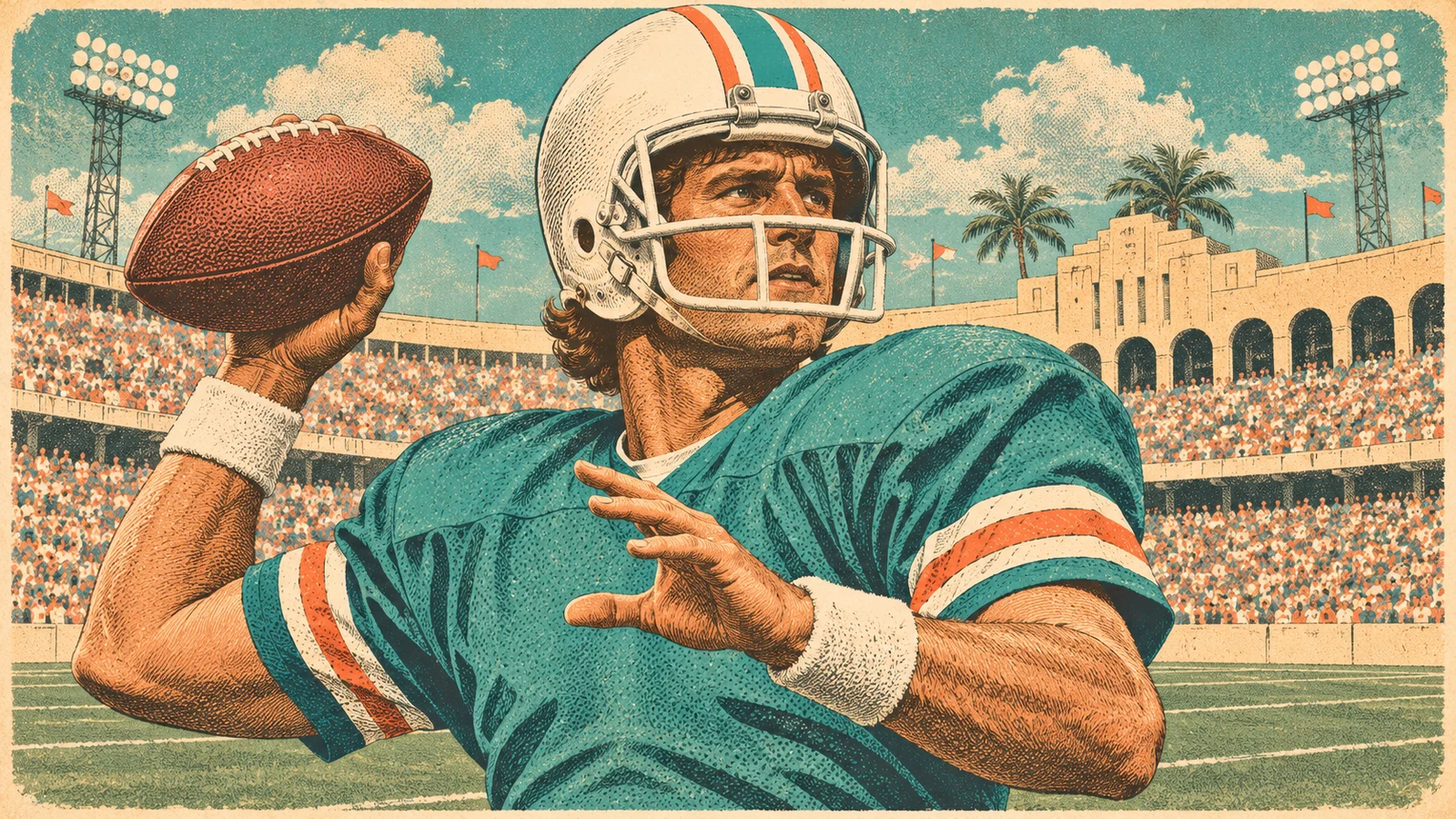

In 1984 Dan Marino threw 48 touchdown passes and took just 13 sacks. A defense that did everything right for the first two seconds could still watch a touchdown pass sail over its cornerback. A dozen seasons earlier the Dolphins had solved a different problem: opponents knew Miami wanted to run and still couldnât stop the Dolphins from winning every game. Put those two teamsâ personnel on the same draft board and you have to decide what a great Miami offense actually wants to do.
Our order rewards dominance against contemporaries, production in a Dolphins uniform and how much a player changed his teammatesâ assignments. It credits the undefeated team in full, and also gives the 1980s offense and the turn-of-the-century defense a chance to make their own cases.
1. Dan Marino, quarterback
Miamiâs 1984 totals look extravagant even before you consider the era: 5,084 passing yards in 16 games, those 48 touchdowns, and nine yards per attempt. His release let the Dolphins use the whole field without needing a clean pocket for very long. The best all-time offense in Miami begins with Marino because every other selection can make use of that one advantage.
2. Dwight Stephenson, center
A quarterback who lets the ball go quickly still needs space to step forward. Stephenson could give Marino that space without requiring both guards to turn inward and help. He was also mobile enough to reach a defender moving across his face on a run. A knee injury shortened his career, but the quality of his work at the junction of Miamiâs two styles gives him second place.
3. Larry Csonka, fullback
A defense facing Csonka had to spend a body on the interior run before worrying about either flank. One arm around his waist rarely ended the play where the tackler intended. He and Mercury Morris each reached 1,000 rushing yards in the perfect season, then Csonka was the MVP when the Dolphins repeated as champions the following year. His own rushing line captures only part of what Morris gained from his presence.
4. Jason Taylor, defensive end
Taylor recorded 131 sacks for Miami, and a tackle trying to stop him had to account for his hands as much as his speed. He could turn a sack into a loose ball or retreat into the lane where a quarterback expected to find his outlet. He is the first defender on this board because the offense has to locate him even when the call sends him away from the quarterback.
5. Bob Griese, quarterback
The perfect season alone understates Grieseâs case, and also belongs partly to Earl Morrall, who carried the job while Griese was injured. Grieseâs distinguishing skill was command. He could recognize where the advantage lay, keep his blockers pointed at it and throw when the defense finally overplayed the handoff. With Miamiâs original backfield and Shulaâs pacing, he might be the more natural starter.
6. Zach Thomas, middle linebacker
A blocker who has a clear view of the middle linebacker at the snap expects at least a chance to get hands on him. Thomas often met the runner while the blocker was still on his way. His recognition converted modest physical reach into exceptional range. Add him to a front with Taylor and the opposing center has two very different timing problems to solve.
7. Larry Little, guard
Little is the guard we want to take on the road for a fourth-quarter drive. He could fire straight out to clear the inside path for Csonka or get out in front of a runner moving laterally. That made similar backfield action look dangerous in more than one direction. He stays in the lineup when Marino comes in because that credible run makes linebackers hesitate on play-action.
8. Paul Warfield, wide receiver
Warfieldâs raw receiving totals in Miami reflect how often the Dolphins chose to hand off. His effect shows up whenever a safety has to stay deep while Csonka pounds the middle. He could sell a shorter route and change the angle of the chase once the corner committed. Pair him with Marino and the receiver who helped make the running game work gets a much larger menu of throws.
9. Richmond Webb, left tackle
A quick release can hide a great deal. It cannot rescue a quarterback whose blind-side tackle loses immediately. Webb gave Miami years of reliable protection on that edge. He is also a useful test of our rankings: the Dolphins have flashier offensive stars, but losing Webb changes the assignment for the tight end, the running back and the quarterback on the same down.
10. Nick Buoniconti, middle linebacker
The heart of the No-Name Defense rarely let an offense collect the easy yards its design promised. Buoniconti diagnosed runs quickly and could hold the middle of a pass defense when a quarterback tried to throw behind a teammate. With Thomas also on the roster, there is a genuine choice. Pick Buoniconti to captain a recreation of the 1972 defense. Pick Thomas to range behind our mixed-era front.
11. Mark Clayton, wide receiver
Clayton caught 18 touchdown passes in 1984. Near the goal line, where a receiver has less room to run away from anyone, timing and the ability to find a window become even more important. Marino and Clayton shared an understanding of when the ball should leave the hand. That makes him our first choice when a drive reaches the opponentâs 15.
12. Jim Langer, center
The unbeaten team had its own exceptional center. Langer coordinated a line built to keep the backfield moving forward regardless of who carried the ball or took the snap. He loses narrowly to Stephenson because our starter is Marino. Give Griese the huddle, call a steady diet of inside runs and that decision can reasonably go the other way.
13. Bob Kuechenberg, guard
Kuechenberg is the lineâs answer to an injury or a difficult matchup. His primary job was at guard, but he could move when the Dolphins needed help elsewhere. Alongside Langer and Little, he helped make power running a dependable option against opponents preparing specifically to stop it. On this roster he stays at left guard and lets Stephenson handle the calls.
14. Mark Duper, wide receiver
Duper gives the formation its longest dimension. A defense trying to crowd Claytonâs routes inside has to decide whether its outside corner can run with Duper all afternoon. He is also why a three-wide Miami offense makes sense even with Warfield on the roster. There are two sides of the field, and an opponent usually has only one exceptional deep safety.
15. Jake Scott, safety
Scott intercepted two passes in Super Bowl VII and was named MVP. His place here rests on the responsibility behind those plays: judge the flight, keep the deepest receiver in front and still arrive early enough to take possession. That skill travels. Even with Taylor pressuring the passer, this all-time defense needs somebody who can finish a hurried throw.
Which Dolphins team would you send out on third-and-three?
There are two coherent answers. With Griese and the 1972 core, put Csonka and Morris together, give Little room to pull, and make the defense choose between an inside collision and the edge. With Marino, spread Warfield, Clayton and Duper across the field, keep a back who can pick up pressure, and let the quarterback choose the matchup before the pass rush develops. Mixing the personnel is easy. Deciding what the offense does well enough to repeat under pressure is the real draft.
An all-time Dolphins starting lineup
Offense QB Dan Marino, RB Larry Csonka, receivers Paul Warfield, Mark Clayton and Mark Duper, TE Keith Jackson. LT Richmond Webb, LG Bob Kuechenberg, C Dwight Stephenson, RG Larry Little, RT Norm Evans. Mercury Morris enters in the two-back package.
Defense Jason Taylor, Bob Baumhower, Manny Fernandez and Cameron Wake up front. Zach Thomas in the middle, with John Offerdahl and A.J. Duhe available for different fronts. Patrick Surtain and Sam Madison at corner, Jake Scott and Dick Anderson at safety.
Build a 17-0 team in FSN All-Timers
Follow Miami Dolphins coverage on FSN.
Explore all 32 franchise draft boards and FSNâs greatest NFL teams.