
















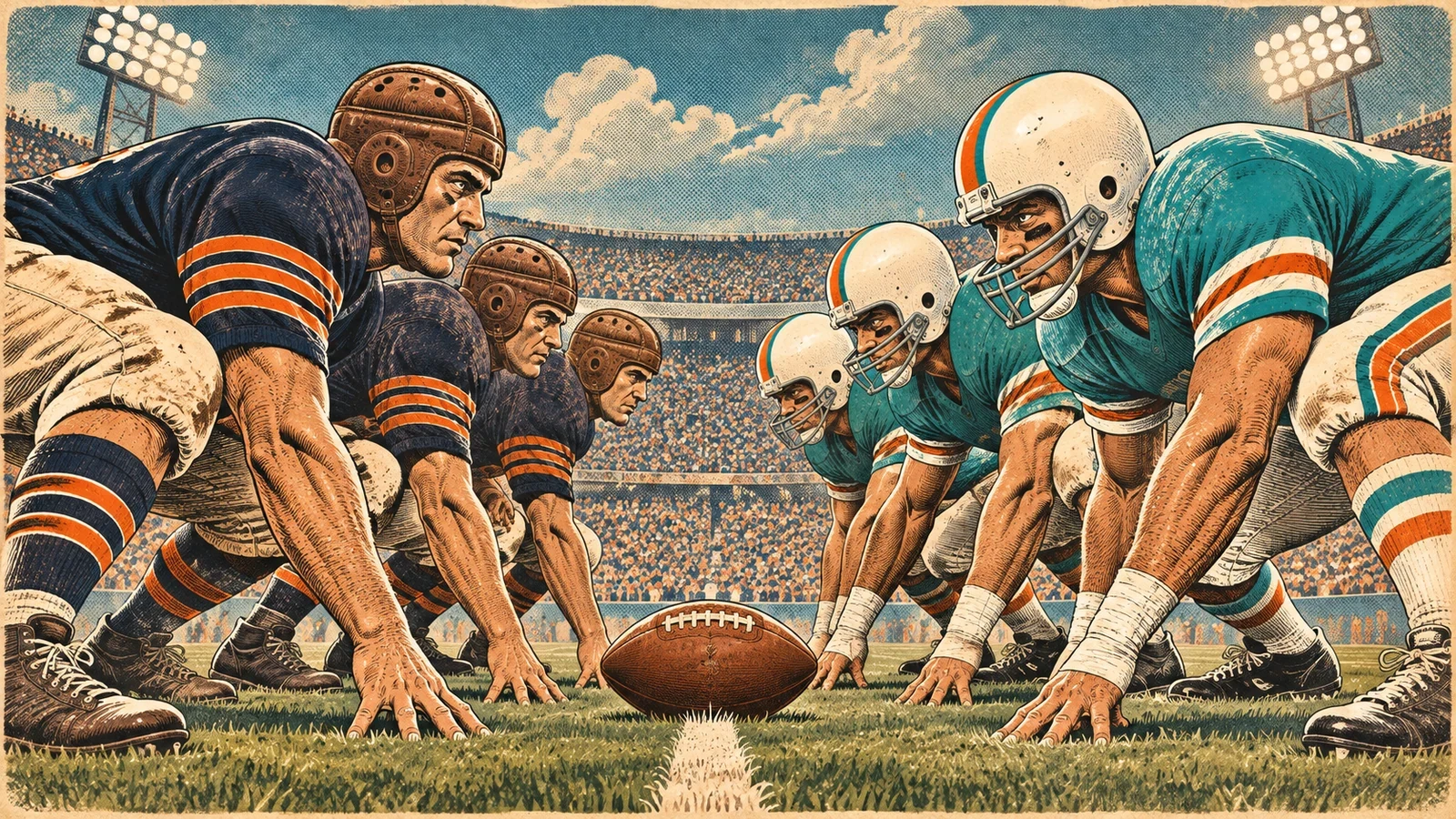

On a neutral grass field, with both championship rosters healthy and a common set of 1985 playing rules, I would give the Bears a narrow edge. Miami has the better case for historical greatness because it finished unbeaten. Chicago has the personnel I would choose for the specific job of getting the Dolphins behind schedule on first down.
The first handoff is almost a trick question. Larry Csonka can attack inside or Mercury Morris can test the corner. The harder question for Don Shula is what he calls if both gain two yards. Third-and-six against this Chicago front is a very different game from third-and-two.
What Miami can do to the 46
The Dolphins had two 1,000-yard rushers in a 14-game regular season. Csonka finished with 1,117 yards and Morris with 1,000. Chicago’s crowded front asks the interior blockers to account for defenders right across their faces. Center Jim Langer and guard Larry Little give Miami two credible answers to that demand. Csonka needs daylight for a step or two to make his size count.
I would show the inside run and get Morris outside early, even if the first try produces little. Make Chicago’s edge defender decide how far he can close down. Give him two chances to guess and Csonka might get a crease straight through an area that appeared blocked before the snap. The strength of having two backs with different skills is what the second call can do to a defense that stopped the first.
Paul Warfield is Miami’s best chance at a quick score
Warfield averaged more than 20 yards per catch in 1972. One reason his raw total looks modest is how often Miami handed off. Bob Griese could use that history against a safety taking even one eager step toward the line. Chicago has the rush to make a long drop uncomfortable, so the deep shot needs a convincing run action and enough protection to give Warfield a clean release.
A common shortcut in this debate gives Miami Dan Marino. Marino’s 1985 Dolphins handed Chicago its lone regular-season defeat, 38-24. The 1972 club belongs to Griese and Earl Morrall, and runs a different offense. That December result shows the Bears could be beaten. It supplies no evidence that the 1972 team could duplicate the same passing plan.
Miami’s defense has a say in Walter Payton’s afternoon
Miami led the NFL in scoring defense in 1972. Nick Buoniconti had the instincts to get the defense pointed toward a run before Payton received the ball. Safety Jake Scott could punish an inaccurate throw if Jim McMahon tried to squeeze a ball behind the linebackers. Getting Chicago to throw from its own end would be a genuine Miami victory.
Payton gives Chicago a slightly wider set of answers on an ordinary second down. A checkdown can keep the drive moving if Miami’s coverage takes away the first read. Running him behind the same blockers on the next play makes the defense close from a different angle. Shula’s team can survive several long drives if it forces field goals at the end of them.
Why FSN leans Chicago
The Bears allowed no points in their first two playoff games and ten in the Super Bowl. My tiebreaker is what happens after a negative play. Chicago has a plausible short completion to Payton when a run loses yardage. Miami becomes more dependent on timing a throw before the rush gets to Griese. A single big completion to Warfield could erase that difference.
For a team-building exercise, try making Miami’s choice first. Spend your strongest early pick on the interior line and see which runners you can put behind it. Then start from the other side of the ball and draft the first defender you would trust to split that block on third-and-one.
Build your own championship roster in FSN All-Timers