
















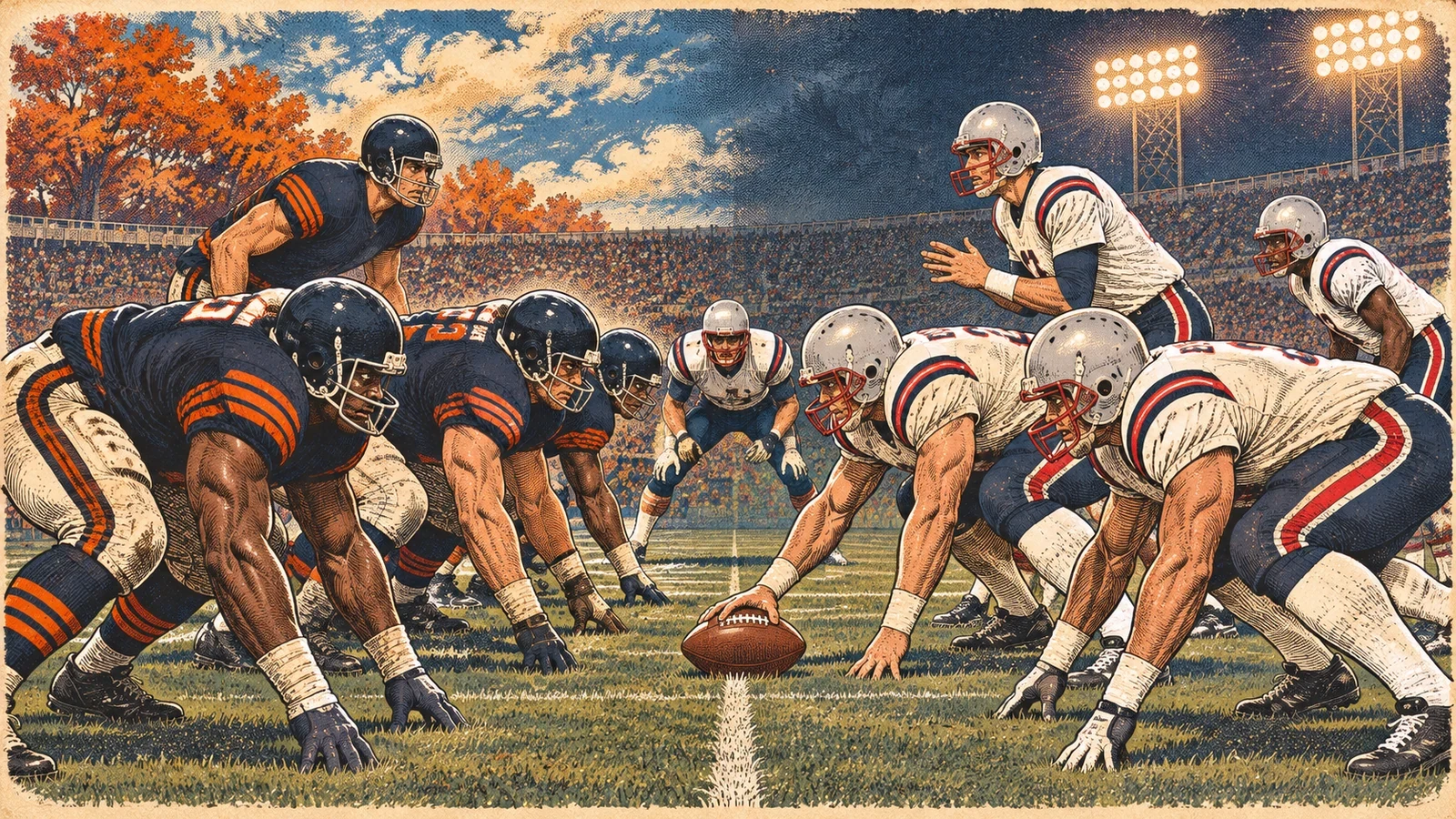

I would take the 2007 Patriots by one possession on a neutral field under 2007 rules. The player who tips it for me is Wes Welker. Chicago could find a second defender to follow Randy Moss or an extra rusher to hurry Tom Brady. Welker could make either decision expensive before the pass rush had time to matter.
Change the conditions to a windy game on grass with more contact downfield and I lean toward Chicago. This is FSN’s football judgment about a game the teams never played. Here is the possession I would want to watch.
Third-and-four belongs to Welker
The 1985 Bears could crowd the line, cover the center and both guards, and leave the offense guessing which threats would come. That pressure could ruin a run before it developed. Against New England’s spread, the same alignment left fewer bodies to handle a receiver releasing inside from the slot. A five-yard completion would move the chains before a free rusher could arrive.
Brady threw 50 regular-season touchdowns in 2007. Moss caught 23 of them, and Welker caught 112 passes. Moss demanded the deep safety’s attention even on a drive where he never touched the ball. Welker could make his break in the space that safety vacated. Chicago’s answer would be to disguise the rush, close the first throwing lane and force Brady to hold the ball for a second read.
Chicago’s best answer happened in another Super Bowl
The Giants sacked Brady five times in Super Bowl XLII and held an offense that had scored 589 regular-season points to 14. The lesson for Chicago concerns the number of men it sends. If Richard Dent, Dan Hampton, Steve McMichael and the rest of the front can win with four, Mike Singletary can stay underneath and the secondary can keep help over Moss. One successful rush buys two pieces of coverage.
That plan also has a cost. On a down when New England runs against a lighter box, the Bears have to tackle cleanly enough to keep the next play out of third-and-short. Send the extra man the next time and Brady has a reason to look for Welker immediately. Those consecutive calls matter more than the name of the defensive formation.
Walter Payton can keep the experiment short
Chicago’s offense belongs in the argument. Payton could take an inside handoff, catch the outlet or pick up a rusher for Jim McMahon. Let him handle second-and-five and the playbook stays open. Force Chicago into second-and-thirteen and New England can play the pass without having to honor the same run action.
Chicago shut out the Giants 21-0 and the Rams 24-0 before beating New England’s 1985 team 46-10 in Super Bowl XX. That sequence shows what a lead meant to the Bears. An opponent chasing two scores could no longer choose the safer way around their front. The Patriots facing them in this thought experiment have Brady, Moss and Welker, an entirely different set of problems from the one Chicago solved in New Orleans.
The opening series I would script
Put Moss alone outside and Welker inside on the opposite side. Give Brady a short answer on the first snap. If Chicago sits on it, bring the back into protection on the next passing down and give Moss time to run beyond the corner. On the other sideline, I would give Payton the first touch and move McMahon’s launch point on the next throw. Make both defenses defend the width of the field early.
My pick changes if Chicago can close the game with its front four. The single most telling play would be a routine-looking third-down incompletion in the second quarter. If the Bears can force one while keeping two defenders deep, the advantage I gave New England starts to disappear.
Draft your answer to the Bears and Patriots in FSN All-Timers