















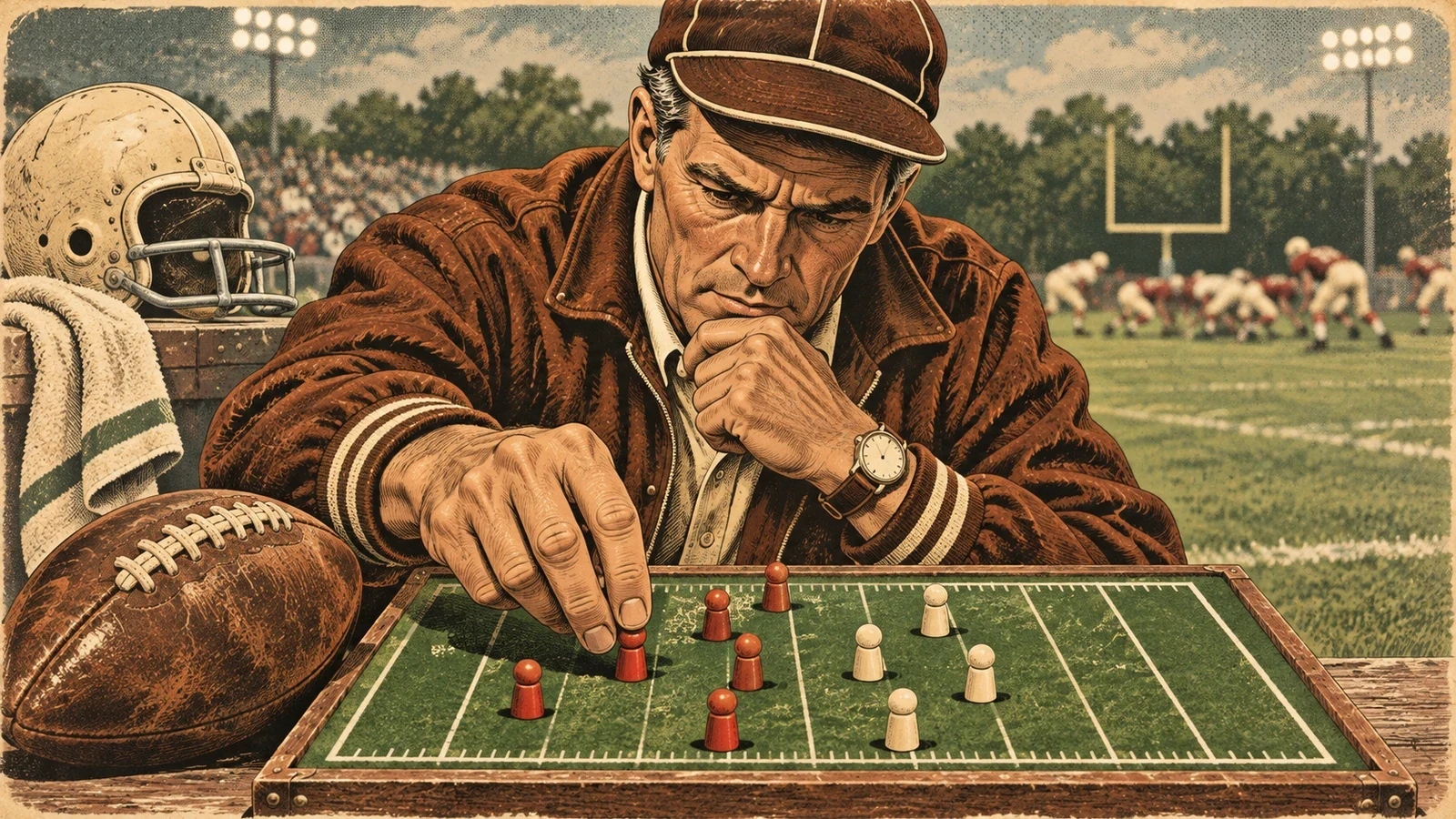
Two picks remain. Your open spots are a second wide receiver and an edge rusher. The board offers a receiver with better hands than your first pick and a pass rusher who can keep a quarterback from stepping up. I’d take the rusher. You already have a way to beat single coverage. Getting pressure gives you a chance against a team that can score as quickly as you can.
That’s the kind of choice FSN All-Timers asks you to make over ten rounds. You fill nine player spots and choose one historical offensive line, then play a 17-game regular season. Here’s how I’d spend the picks and use the rematch to find out which one mattered.
Read the open positions before spending the re-deal
You need a quarterback, a running back, two wide receivers, a tight end, an offensive line, an edge rusher, a linebacker and two defensive backs. Once you fill EDGE, another edge rusher drops out of future boards. Draft a corner early and you still have a second DB spot for a safety. With one pick left, every card on the board fits that last position.
Pittsburgh makes the trade-off easy to see. The 2021 T.J. Watt and 2008 James Harrison cards both use the single EDGE spot. The 1975 Mel Blount and 2010 Troy Polamalu cards can play together in your two DB spots. I’d use the one re-deal when none of the available choices solves a problem I still have. If two cards both help, I’d take one and save the re-deal.
Read the year and the traits on the card
Dan Marino threw 48 touchdown passes in 1984. Peyton Manning threw 49 in 2004. Both seasons are in the draft. Faced with those cards, I’d spend less time on the one-touchdown difference and more on which passer suits my receivers and line. The card grade gives you a quick comparison. Your opponent and weekly game plan still have a say in the score.
Jerry Rice’s card is his 1995 San Francisco season, when he caught 122 passes for 1,848 yards. His route running makes him a strong choice if your first receiver already supplies deep speed. Rice’s shorter routes give the quarterback somewhere to go when pressure arrives before a deep route develops.
Give the offense a second way to make a first down
Imagine three consecutive plays. First, the deep throw is covered. Next, an inside run gains two yards. On third-and-eight, who can still get you a first down? A tight end who uncovers between the hashes or a receiver who wins at the sticks can add more to this team than a second deep threat.
The same question works on defense. An edge rusher pairs naturally with a defensive back who can make the quarterback hold the ball. When the next opponent appears, read its strengths before choosing a weekly plan. After the game, open the result and look at what decided it. That’s where I’d check whether the pressure I drafted actually helped.
Use the Daily Challenge for a friendly rematch
Two friends starting the same Daily get the same starting conditions and schedule. While your earlier picks and re-deals match, you can compare the same options. Once one of you takes a quarterback and the other takes a receiver, you have different slots to fill. Write down that first disagreement. It gives you something more interesting to compare than final records alone.
What should you do after a 16-1 season?
Look first at the loss, then at the closest wins. A single late turnover may explain the loss without identifying a draft mistake. Three close wins in which your offense struggled against pressure give you a reason to revisit the line. On the season results screen, choose “Change one pick & replay.” Try replacing the line and see how the same season changes.
How do you go 20-0?
Go 17-0 in the regular season and you earn a bye. Win the divisional round, the conference championship and the Super Bowl to finish 20-0. The roster that can beat the widest range of opponents gets my vote for that run. If your star quarterback got you through September but the line broke down in January, you already know which pick to revisit.
Build your NFL roster and take the 17-0 challenge