
















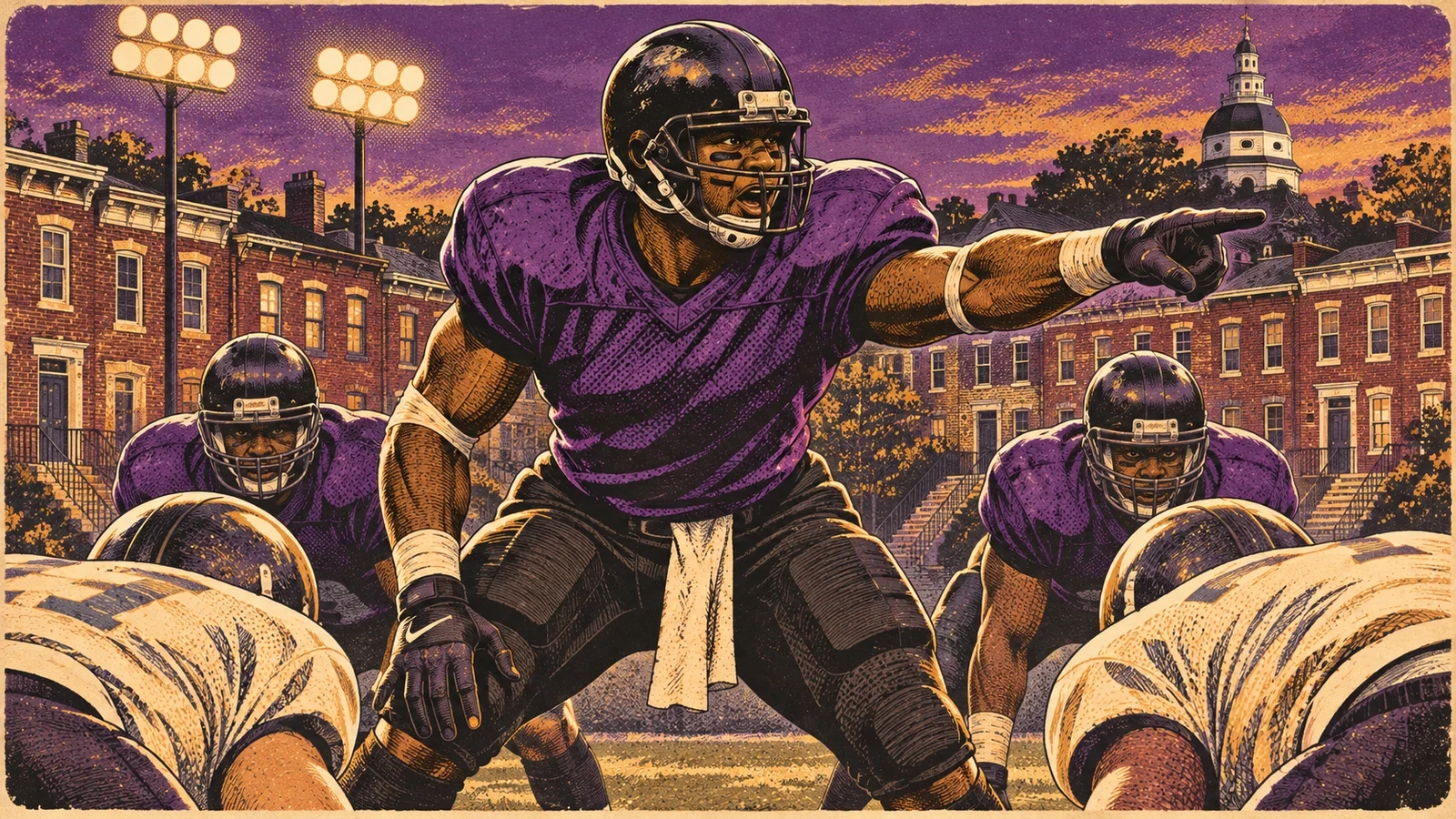

Baltimore asks an unusually good version of the first-pick question. Take the middle linebacker who can straighten out ten other defenders, the safety who can make a sound read turn bad, or the left tackle who can remove a pass rusher from the afternoon? Our board counts Ravens seasons from 1996 onward. Baltimore Colts careers belong to the Colts’ franchise history. We balance era, peak and sustained value in Baltimore, with a premium on the players who gave an entire unit its identity.
1. Ray Lewis, middle linebacker
The 2000 defense allowed 165 points in a 16-game regular season. Lewis supplied the part at the center that a season total cannot describe. He could identify where a combination block was headed and attack the crease before the guard had climbed to him. In a defensive huddle assembled from several decades, he also gets the call sheet.
2. Ed Reed, safety
A throw can be open when the quarterback decides to make it and covered when the ball arrives. Reed built a career in that interval. He intercepted 64 regular-season passes for Baltimore while giving offenses reasons to hesitate on many more. Place him behind strong corners and he can read the quarterback rather than rescue a bad matchup.
3. Jonathan Ogden, left tackle
Ogden played with the reach to turn a speed rusher wide and the power to make a defense reinforce his side against the run. That is a rare package even among great tackles. On a roster built around Lamar Jackson, a play can extend in either direction. The lineman who can maintain his block after the launch point moves is particularly valuable.
4. Lamar Jackson, quarterback
The handoff itself becomes a more complicated play when Jackson is carrying out the fake. An edge defender who chases the back too quickly gives the quarterback open grass. Jackson’s MVP seasons in 2019 and 2023 also showed how the passing game punishes defenses that crowd the run. He is the offensive player who most changes our opponent’s week of preparation.
5. Terrell Suggs, edge defender
Taking an edge rusher usually means paying for third down. Suggs also earns his spot on first down, when he can hold the line against a tackle and make the runner turn toward Lewis. That ability to defend both possibilities from the same alignment is why his pairing with an interior disruptor works so well.
6. Marshal Yanda, guard
Yanda solved the less glamorous half of the protection problem. He could take a powerful tackle one-on-one inside and still move with the back on a running play. With Ogden outside and Yanda inside, Baltimore can declare the run, invite the defense to load the box, and still give Jackson room to choose.
7. Jamal Lewis, running back
Lewis ran for 2,066 yards in 2003. The way the yards arrived matters to our team: a safety meeting him square still had to stop his momentum. A defense that widens to contain Jackson leaves lighter bodies inside to meet Lewis. Each player makes the opponent pay for its preferred answer to the other.
One defensive spot changes the call
Haloti Ngata is the next pick if the opponent lives on inside runs. Chris McAlister comes first if the other side can isolate our second corner. The more interesting choice is on offense. Taking Mark Andrews lets Baltimore threaten the seam from a heavy formation. Taking Derrick Mason gives it a receiver who can separate outside when the defense sits on the run. We would start with Andrews and make the opponent commit its safeties first.
An all-time Ravens draft roster
Offensive selections QB Lamar Jackson, RB Jamal Lewis, WRs Derrick Mason and Anquan Boldin, TE Mark Andrews. Jonathan Ogden and Marshal Yanda anchor the line. Todd Heap gives the two-tight-end package a receiving threat.
Defensive selections Edge Terrell Suggs, interior Haloti Ngata, LB Ray Lewis, CB Chris McAlister and S Ed Reed. Peter Boulware supplies the extra edge speed on long-yardage downs.
Build a 17-0 team in FSN All-Timers
Follow Baltimore Ravens coverage on FSN.
Explore all 32 franchise draft boards and FSN’s greatest NFL teams.