















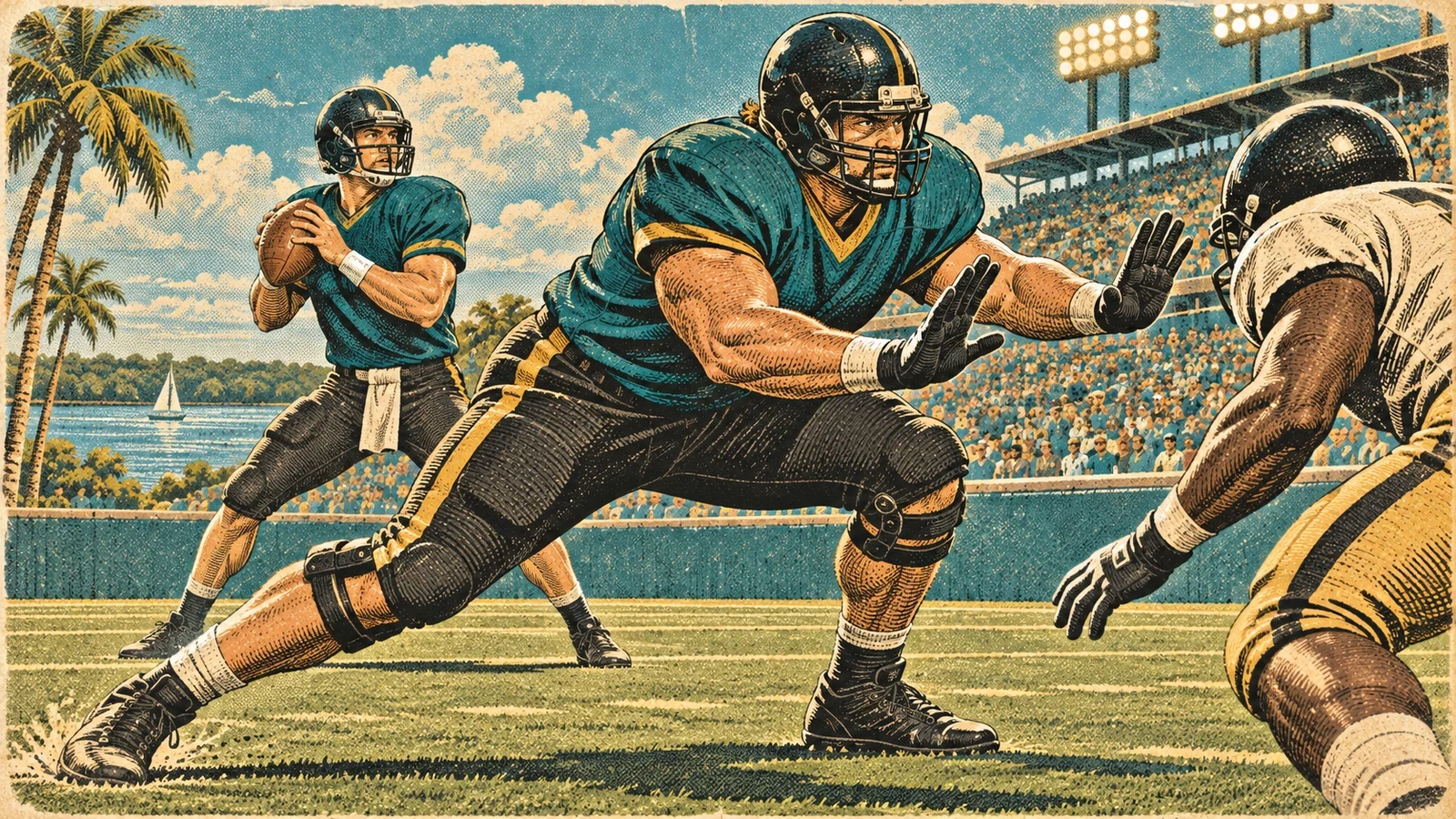

An expansion-team exercise usually begins with a quarterback who has to survive until help arrives. Jacksonville drafted the help first. Tony Boselli was the first selection the franchise ever made. The teams that soon reached two AFC championship games played football that made the decision look sensible: run off tackle, sell the fake and give Mark Brunell enough space to attack the sideline. That is the starting point for a board that also gives Jacksonville’s later defenses their turn.
1. Tony Boselli, left tackle
An injury-shortened career limits the volume of his résumé. At his peak, Jacksonville could give him an elite pass rusher without committing a back or tight end to the same assignment. His work against Bruce Smith in the 1996 playoffs is the natural test case. That freedom elsewhere in the formation earns him first selection.
2. Fred Taylor, running back
Taylor could run through an arm tackle without giving up the speed to beat the next defender. Jacksonville’s career rushing leader brought more than breakaway runs: he could keep a defense in heavier personnel, opening space behind its linebackers. With Boselli on the same side the offense has an identity immediately.
3. Jimmy Smith, wide receiver
Smith caught 862 passes for Jacksonville. He could attack the sideline deep enough to pull safety help, then come back to the ball with the strength to win through a corner. A team that already has Taylor needs a receiver who makes it costly to crowd the box. Smith did that job for years.
4. Maurice Jones-Drew, running back
His low center of gravity made it difficult for a defender to find a useful angle in traffic. He led the NFL in rushing in 2011 on a team whose intentions were seldom mysterious. Taylor remains the first choice for this offense. Jones-Drew is the change we would make for goal-line runs and for a back who can contribute in the return game.
5. Tony Brackens, defensive end
Brackens attacked the football as well as the quarterback. For an expansion-era defense learning how to close a game, the possibility of a forced fumble carried particular weight. He is our first homegrown edge choice and a useful partner for a more powerful lineman on the opposite side.
6. Mark Brunell, quarterback
A left-handed quarterback rolling away from pressure asks unfamiliar questions of a secondary. Brunell could threaten the edge with his feet and still throw downfield after he left the pocket. His best fit is exactly the receiver pair we can give him: Jimmy Smith outside and Keenan McCardell working into the space that opens underneath.
7. Calais Campbell, defensive lineman
His Jacksonville run was much shorter than his full career, but the 2017 defense is difficult to imagine without him. He could overpower a tackle from the edge or move inside in a passing formation. That flexibility gave a defense with excellent corners multiple ways to hurry a quarterback without sending a blitz.
The cornerback choice depends on the opponent
Rashean Mathis gives Jacksonville a long body of work and the hands to turn a rushed pass into points. Jalen Ramsey’s Jaguars peak offers an unusually good solution to a big receiver who wants to play outside the numbers. Start both. A pass rush with Campbell and Brackens can afford the occasional risk outside, and a run-first opponent gives us a good reason to add John Henderson and Marcus Stroud side by side.
An all-time Jaguars draft roster
Offensive selections QB Mark Brunell, RB Fred Taylor, WRs Jimmy Smith and Keenan McCardell, TE Marcedes Lewis. LT Tony Boselli and C Brad Meester set the protection. Maurice Jones-Drew gets the short-yardage series.
Defensive selections Calais Campbell and Tony Brackens outside, John Henderson and Marcus Stroud inside, with Daryl Smith at linebacker. Put Rashean Mathis and Jalen Ramsey at corner and let Donovin Darius play the alley.
Build a 17-0 team in FSN All-Timers
Follow Jacksonville Jaguars coverage on FSN.
Explore all 32 franchise draft boards and FSN’s greatest NFL teams.