














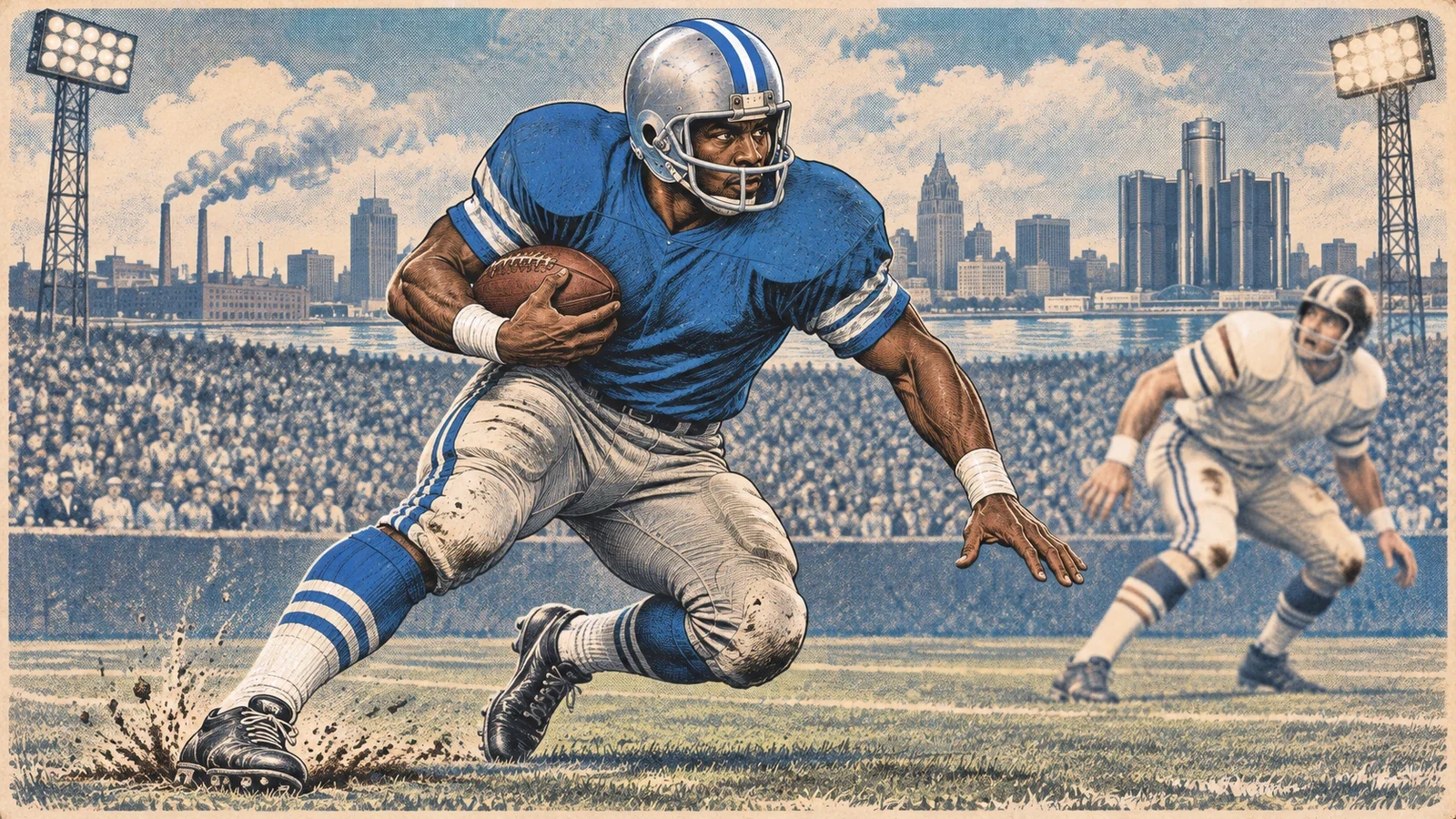
The best argument for Calvin Johnson as Detroit’s first pick is what his presence would have done for Barry Sanders. A deep safety shaded toward Johnson is one fewer defender waiting behind the linebacker Sanders has just beaten. Reverse the exercise and the same logic applies. Our first two Lions are an unusually good pair. The rest of the board gives the championship teams of the 1950s their say about what a complete Detroit roster looks like.
1. Barry Sanders, running back
Sanders gained 15,269 yards in ten seasons, often finding a path that was no longer on the diagram. The gamble was real: an improvised cut could lose a yard as readily as it could gain twenty. We accept that cost because a defense that had closed the obvious gap still had to make a tackle in space.
2. Calvin Johnson, wide receiver
Johnson’s 1,964 receiving yards in 2012 put a number on the coverage problem. A corner in good position could still lose the catch above his head, so a safety had to stay close enough to matter. On this team the defense must decide whether to leave that safety with Johnson or closer to Sanders.
3. Joe Schmidt, middle linebacker
Schmidt organized a championship defense in an era when the middle linebacker’s job was taking its modern shape. His recognition let the rest of the front attack without abandoning the middle. He is the first defender on the board because the unit needs someone who can set its alignment and still finish the play.
4. Night Train Lane, cornerback
Lane’s famous 14-interception rookie season belonged to the Rams. His Detroit case stands on the years when he made the boundary a hazardous throw and paired with an exceptional secondary. We select him for press and ball skills that would matter under any rules, while making clear that modern contact restrictions would change his technique.
5. Lem Barney, cornerback and returner
Barney intercepted ten passes as a rookie in Detroit. His return ability makes those takeaways more valuable than a change of possession at the catch point. Opposite Lane he also makes it harder for an opponent to protect its quarterback simply by throwing toward the other corner all afternoon.
6. Bobby Layne, quarterback
Layne takes the first championship-era offensive spot because of how he handled the final possession. His Detroit teams could win a field-position game and still trust their quarterback when time became the scarce resource. A different offense built around repeated downfield throws would have every reason to choose Matthew Stafford.
7. Alex Karras, defensive tackle
Karras was quick enough to attack a gap before a guard could settle his weight and strong enough to hold his position when a run came at him. On a secondary-heavy all-time board that interior pressure matters. Even great corners prefer covering the first route to chasing the third.
The quarterback and the spare safety
We would start Stafford for this particular offense. His 45,109 passing yards for Detroit include a long partnership with Johnson, and he can reach the opposite sideline when the defense crowds Sanders’ side. Layne ranks higher on our historical board for his championship work. On defense, Yale Lary is the first extra selection: he gives Detroit deep coverage and a punter without using another spot.
An all-time Lions draft roster
Offensive selections QB Matthew Stafford, RB Barry Sanders, WRs Calvin Johnson and Herman Moore, TE Charlie Sanders. Lomas Brown anchors the left side and Kevin Glover directs the line. Bobby Layne is the alternative for a two-minute finish.
Defensive selections Alex Karras and Roger Brown inside, Robert Porcher outside, Joe Schmidt at linebacker. Start Night Train Lane and Lem Barney at corner with Yale Lary and Jack Christiansen behind them.
Build a 17-0 team in FSN All-Timers
Follow Detroit Lions coverage on FSN.
Explore all 32 franchise draft boards and FSN’s greatest NFL teams.