















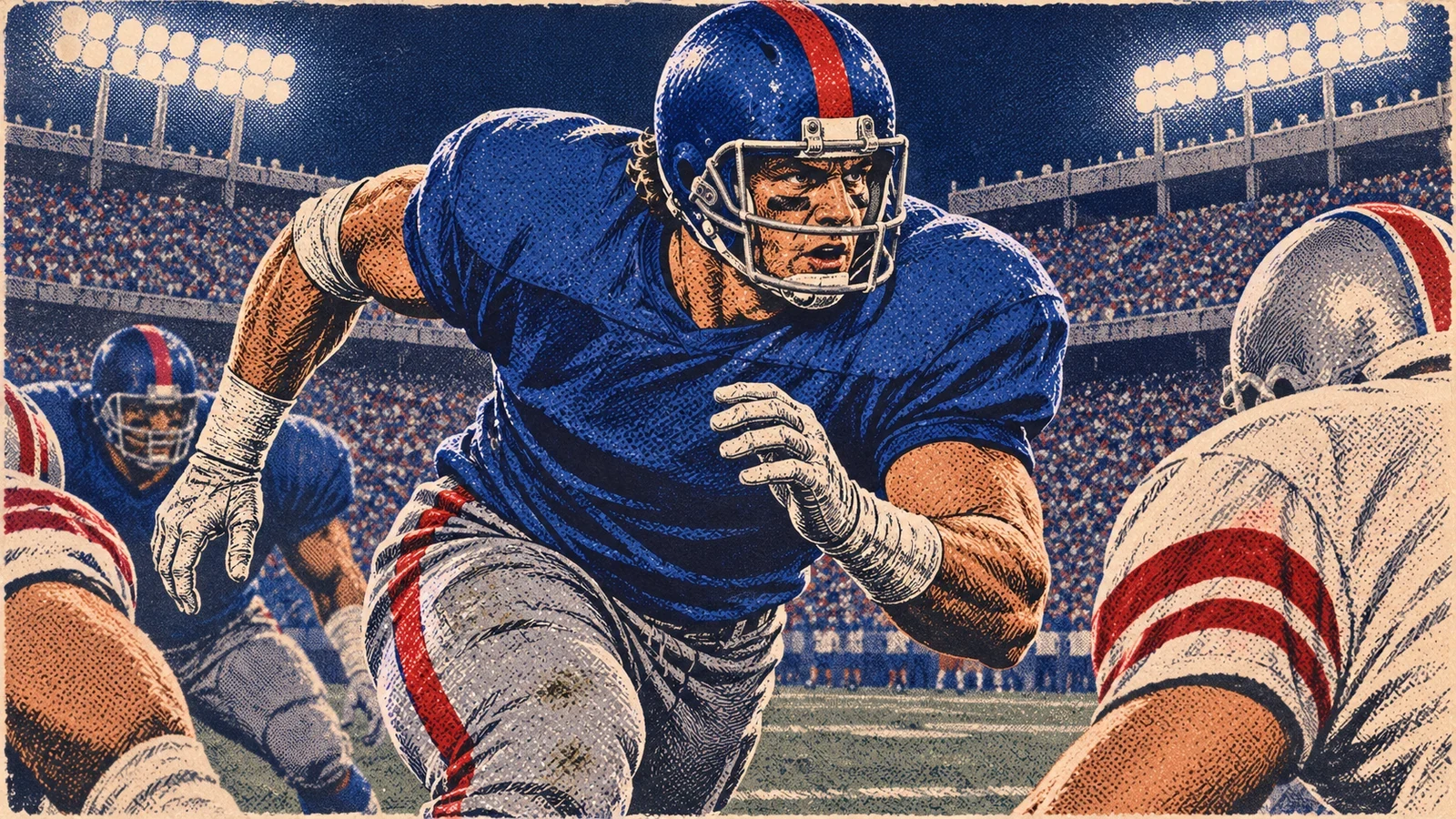
There is a useful way to test an all-time Giant: draw the opposing team’s first play, then add the player to the formation. Nobody changes that drawing faster than Lawrence Taylor. A tight end has to check the protection. The back may need to stay in. A receiver suddenly has one fewer teammate drawing coverage. This ranking follows the Giants through their early NFL championships and modern Super Bowls and rewards that sort of effect as well as career production.
1. Lawrence Taylor, linebacker
In 1986 Taylor won league MVP with 20½ sacks as the Giants went on to win Super Bowl XXI. The greatest advantage was having a rush threat who arrived with that force from a linebacker’s alignment. A line cannot point its protection the same way for every front when Taylor is free to move.
2. Mel Hein, center and linebacker
Hein earned the league’s 1938 MVP honor while doing demanding work on both sides of the ball. He directed the offense’s first contact as a center and diagnosed the other team’s intentions as a linebacker. Let him start at center in a modern lineup. The understanding built on defense is one reason to entrust him with the protections.
3. Michael Strahan, defensive end
Strahan set the official single-season sack mark at 22½ in 2001, but he could also handle an opponent determined to run at him. His final Giants team showed what four excellent rushers could do to an unbeaten passing offense in Super Bowl XLII. Pairing him with Taylor makes it very difficult to choose which tackle gets the extra blocker.
4. Frank Gifford, back and receiver
The 1956 MVP helped the Giants win the NFL championship as a multidimensional offensive back. He gives this roster a runner who can leave the backfield and function as a receiver without announcing the pass by substituting. On a franchise usually identified with defense, Gifford is the offensive player whose range of assignments most expands the playbook.
5. Emlen Tunnell, safety
Tunnell could turn an opponent’s planned gain into a return in the opposite direction. His experience returning kicks mattered after interceptions too: he could judge when the first cut made sense and when an easy possession was enough. Give him Taylor’s hurried throws and the secondary gains its own explosive playmaker.
6. Rosey Brown, left tackle
Brown had the athleticism to arrive at the next blocking angle before the runner, an especially important quality for an offense inclined to move its backs around. In a more pass-heavy alignment he takes the blind side. That adaptability gives him the first offensive line selection after Hein.
7. Eli Manning, quarterback
Manning’s finest work came when games stopped allowing a second chance. His sideline throw to Mario Manningham in Super Bowl XLVI is a particularly good example of an aggressive decision rewarded by both placement and a receiver’s feet. Phil Simms was the more accurate passer in his own signature Super Bowl. Manning gets the all-time start by a narrow margin.
The pick after Taylor can change the entire draft
Harry Carson is the obvious partner if Taylor has to roam. Take him early and the defense can play a sound run front even on snaps when Taylor threatens a different gap. If field position is the problem, take Tunnell. On offense Tiki Barber gets the primary rushing job, while Gifford moves between positions. The best career ranking and the best order for filling vacancies are two different exercises.
An all-time Giants draft roster
Offensive selections QB Eli Manning, RB Tiki Barber, WRs Amani Toomer and Odell Beckham Jr., TE Mark Bavaro. Frank Gifford enters as an all-purpose back. Rosey Brown protects the left edge, with Mel Hein at center.
Defensive selections Michael Strahan and Osi Umenyiora at end, Rosey Grier and Leonard Marshall available inside. Lawrence Taylor and Harry Carson lead the linebackers. Emlen Tunnell and Jimmy Patton anchor the secondary.
Build a 17-0 team in FSN All-Timers
Follow New York Giants coverage on FSN.
Explore all 32 franchise draft boards and FSN’s greatest NFL teams.