
















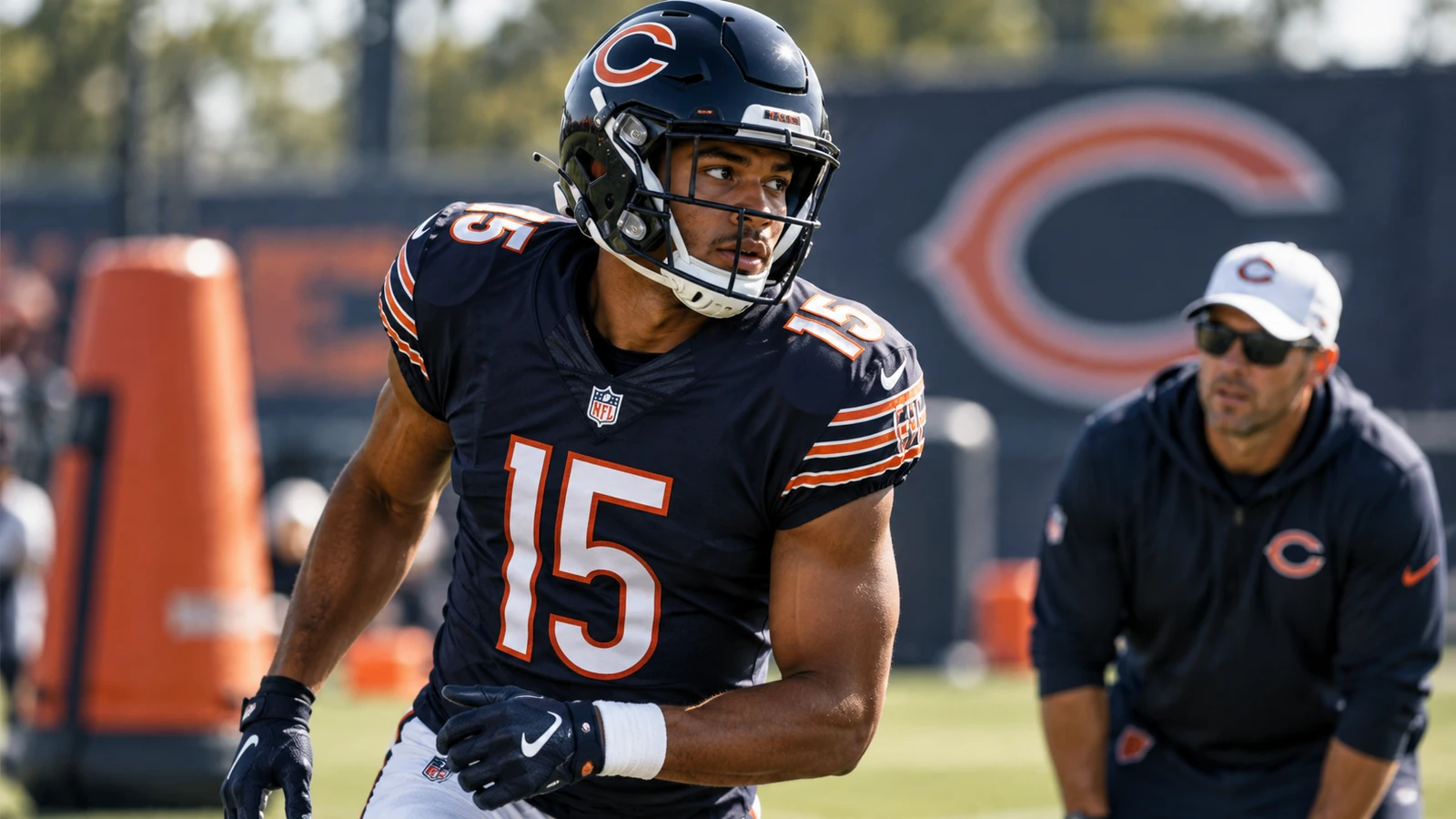

Rome Odunze’s availability has become the biggest offensive injury question for the Chicago Bears entering Week 1. Coach Ben Johnson said Tuesday that Odunze is day-to-day and that the Bears remain hopeful he can play in Sunday’s season opener against the Carolina Panthers, but the wide receiver did not practice Tuesday after leaving the final preseason practice with a leg or foot issue.
The encouraging part of the update is what Chicago is not saying. Johnson indicated the current problem is not related to the stress fracture that caused Odunze to miss five games last season. That distinction lowers the concern that the Bears are dealing with a recurrence of the same injury, even though the team still has not publicly provided a detailed diagnosis for the new issue.
Odunze’s status matters because Chicago’s passing game is built around him
Odunze entered the season positioned as one of Caleb Williams’ most important targets after a 2025 campaign in which he led the Bears with 44 catches for 661 yards and six touchdowns through the first 12 games. The stress fracture interrupted what had been shaping into a major step forward. He returned for the playoffs and added four catches for 88 yards in two games, but the missed regular-season time prevented Chicago from seeing a complete year of the Williams-Odunze connection.
That is why the timing of this new injury is frustrating even if it is considered manageable. The Bears spent the summer building continuity in Ben Johnson’s offense. Odunze had been healthy throughout camp before exiting Thursday’s practice. Losing him immediately before the opener would force Chicago to redistribute targets just as the regular-season plan is supposed to settle into place.
This is not being described as a recurrence of last year’s foot injury
Because Odunze’s 2025 season was interrupted by a stress fracture, any lower-leg or foot problem is going to generate concern. The most important clarification Tuesday was that the Bears do not view the current issue as related to that prior injury. That does not make the new problem irrelevant, but it changes the risk profile.
A recurrence would raise questions about whether the original injury had fully resolved and whether Chicago needed to think in terms of a longer management plan. A separate issue can still keep Odunze out, but it is easier to treat as a normal short-term football injury unless new information changes that assessment.
What the Bears would lose if Odunze cannot play
Odunze gives Williams a big, reliable target who can win at multiple levels of the field. His value is not limited to raw catch totals. He can occupy top coverage attention, give Chicago answers when protection breaks down and create the kind of contested or boundary completions that keep a drive alive when the structure of a play disappears.
If Odunze sits, more pressure would shift toward the rest of the receiving corps and tight ends to replace those targets. Chicago would also have to decide whether to compensate by leaning more heavily on the running game. FSN’s recent analysis of D’Andre Swift’s role in Year 2 of Johnson’s offense is relevant here: a healthier, more efficient rushing attack could become even more important if the Bears open the season without their top outside receiving option.
The official injury report will provide the next useful signal
Chicago’s first required injury report arrives Wednesday, which should provide a more formal description of Odunze’s participation and listed injury. The Bears can then track whether he progresses from no practice to limited work or whether he remains sidelined as the week advances.
That progression matters more than one optimistic phrase. A day-to-day player who returns to practice by the end of the week can still be in good position to play. A receiver who remains out through the final full practices creates a different problem, especially because wideouts need to test acceleration, deceleration and cutting at game speed before a medical clearance means much on Sundays.
Chicago does not need to force the decision early
The Bears have every incentive to keep the door open as long as Odunze is improving. There is no competitive benefit to declaring him out before necessary, and there is no medical benefit to rushing him onto the field simply because the opener is close. The best-case scenario is that he improves through the week and can play without a meaningful restriction. The next-best option is that Chicago makes a clear decision before game day and adjusts the offensive plan accordingly.
The dangerous middle ground would be treating a marginal player as fully healthy and then losing him early in the game. That is why practice participation and next-day response will be important. The Bears need Odunze for more than one Sunday.
What comes next before Bears-Panthers
For now, the situation is more encouraging than alarming. Odunze’s new issue is not being connected to last year’s stress fracture, Johnson remains hopeful about Week 1 and the team has not ruled him out. But he also remains out of practice, which means the Bears still have a real availability question to solve.
Fans can track the broader Week 1 matchup through FSN’s confidence pool rankings. For Chicago, the key update will come from the practice field. If Odunze can get back into team work before Sunday, the Bears have a chance to open the season with the receiving structure they spent the summer building. If not, Ben Johnson’s first regular-season game plan of 2026 will require an immediate adjustment.