
















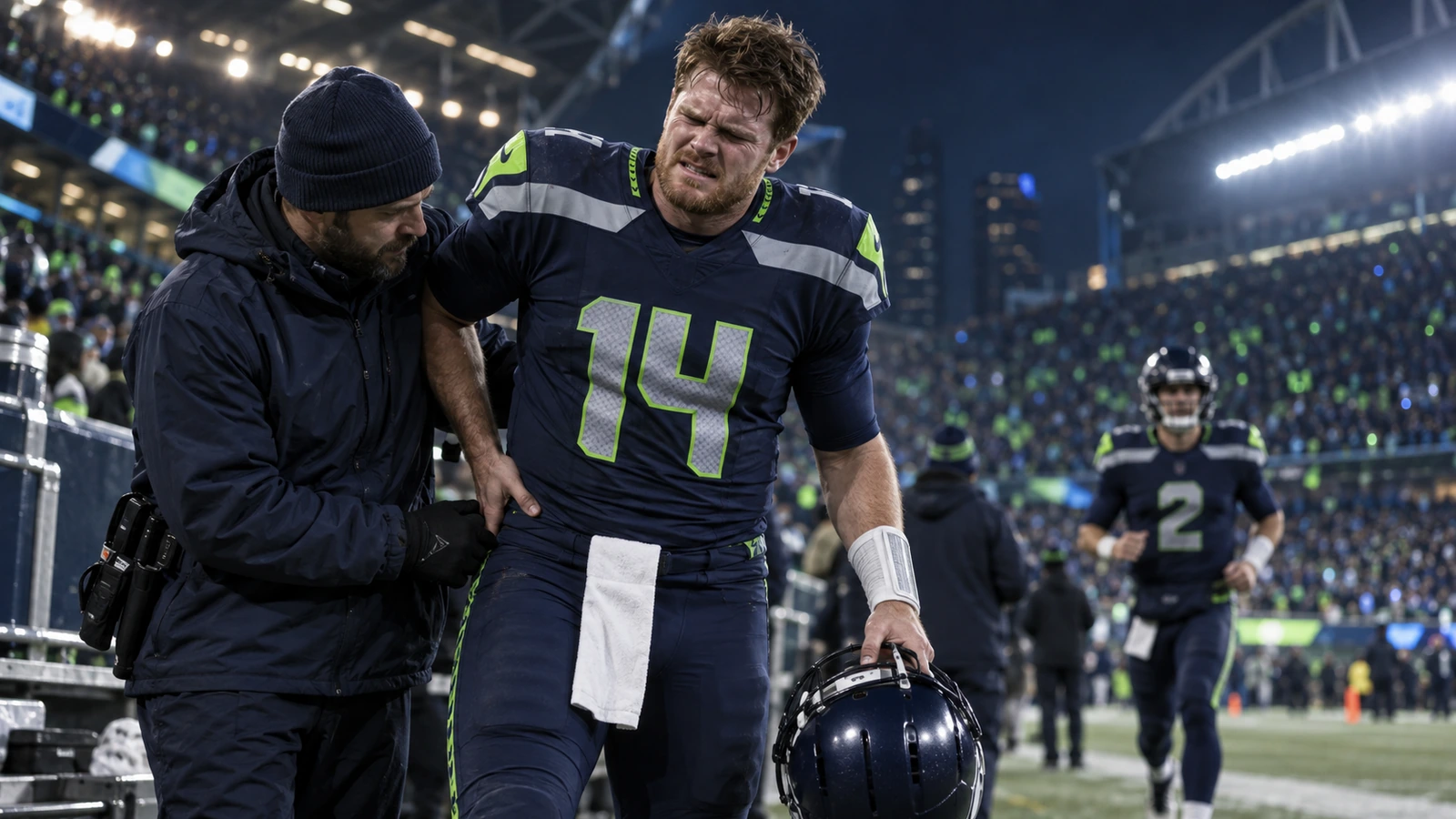

Seattle Seahawks quarterback Sam Darnold was ruled out of the 2026 season opener against the New England Patriots after suffering a hip injury on Seattle’s first possession Wednesday night.
Darnold was injured when Patriots defensive lineman Dre’Mont Jones brought him down while the quarterback tried to escape the pocket on third down. Darnold reached the sideline without assistance but was visibly limping, entered the blue medical tent and later went to the locker room. Seattle initially listed him as questionable to return before ruling him out before halftime.
Drew Lock replaced Darnold and took over an offense that suddenly had to open its Super Bowl defense without the quarterback who led Seattle to the championship last season.
The most important detail for the Seahawks now is what the injury means beyond Wednesday night. As of the in-game announcement, Seattle had not provided a diagnosis or timetable. Reports indicated Darnold was undergoing additional testing, so any conclusion about his Week 2 availability or the severity of the injury would be premature.
Darnold’s night ended almost as soon as it started
The injury came on Seattle’s opening drive. Darnold completed one of two passes for 13 yards before the sack ended the possession and his night.
That timing made the setback especially jarring. Lumen Field had opened the evening in celebration mode as Seattle unveiled its Super Bowl LX championship banner before facing the same Patriots team it beat 29-13 in February. FSN’s Week 1 rematch analysis centered on how much both contenders had changed since the Super Bowl. The first major change during the game was one neither team wanted: Seattle losing its starting quarterback.
Darnold’s injury immediately changed the shape of the matchup. Seattle entered the night with a new offensive coordinator and a reworked backfield, but the quarterback position had been a source of continuity after Darnold’s championship season. That assumption disappeared after one possession.
Drew Lock became Seattle’s emergency plan in real time
Lock is not unfamiliar with Seattle. He previously played for the Seahawks and returned as Darnold’s backup, giving the coaching staff a veteran who understands the environment and has starting experience.
But there is a major difference between preparing all week as the starter and entering after the first drive of the opener. The backup receives fewer first-team repetitions, and the play caller has to decide how much of the original plan can remain intact.
That challenge was visible immediately. Seattle’s offense struggled to sustain drives in the first half while New England’s defense controlled the early pace. Lock was asked to stabilize the game rather than chase it with high-risk throws. He eventually did more than stabilize it: Seattle erased a 10-0 deficit and won 13-10, with Lock finding Jaxon Smith-Njigba for the game-tying touchdown before the Seahawks moved into position for the winning field goal.
For head coach Mike Macdonald, the practical task was straightforward: keep the offense functional, protect the football and give the defense time to keep the score manageable while Lock settled in.
What the Seahawks know — and what they do not
Seattle knows Darnold suffered a hip injury and could not return to the opener. It knows the injury came on a sack and that he was able to leave the field under his own power. It also knows he required further evaluation.
The Seahawks do not yet know, publicly, how much time he could miss.
That distinction matters. Hip injuries can involve a wide range of outcomes, and visual impressions from a player walking off the field are not a medical diagnosis. Until the team releases testing results or a practice-status update, the responsible conclusion is limited to the game itself: Darnold was unavailable and Lock became the quarterback.
The timing creates an immediate Week 2 question
Seattle’s next game is not until Sept. 20 at Arizona, giving Darnold more recovery time than a normal seven-day turnaround. The extended gap could matter if the injury proves minor, but it does not guarantee anything.
If Darnold cannot play, Lock would have a full preparation cycle rather than an in-game emergency. That would allow Seattle to build a plan around his strengths, distribute practice reps accordingly and decide how aggressively to involve the rest of the quarterback room.
The Seahawks built their roster to defend a championship, and Darnold is central to that plan. The difference between a one-night scare and a multiweek absence is therefore enormous.
Darnold’s injury also changes how Seattle evaluates the opener
Seattle’s 13-10 comeback win gives the coaching staff a better problem to solve than a loss would have, but the result does not reduce the importance of the injury. The Seahawks still have to separate the encouraging resilience of the comeback from the disruption created by losing their starter immediately.
That is not an excuse for every offensive problem. Championship teams are expected to absorb injuries better than most. It is context for why the offense’s Week 1 tape may not look like the offense Seattle spent the offseason building.
Darnold’s status now becomes the Seahawks’ first major health story of 2026. Lock proved he could rescue the opener, but Seattle’s preferred formula still begins with Darnold. Until testing provides a clearer answer, the defending champions leave Week 1 with a victory and uncertainty at the sport’s most important position.