
















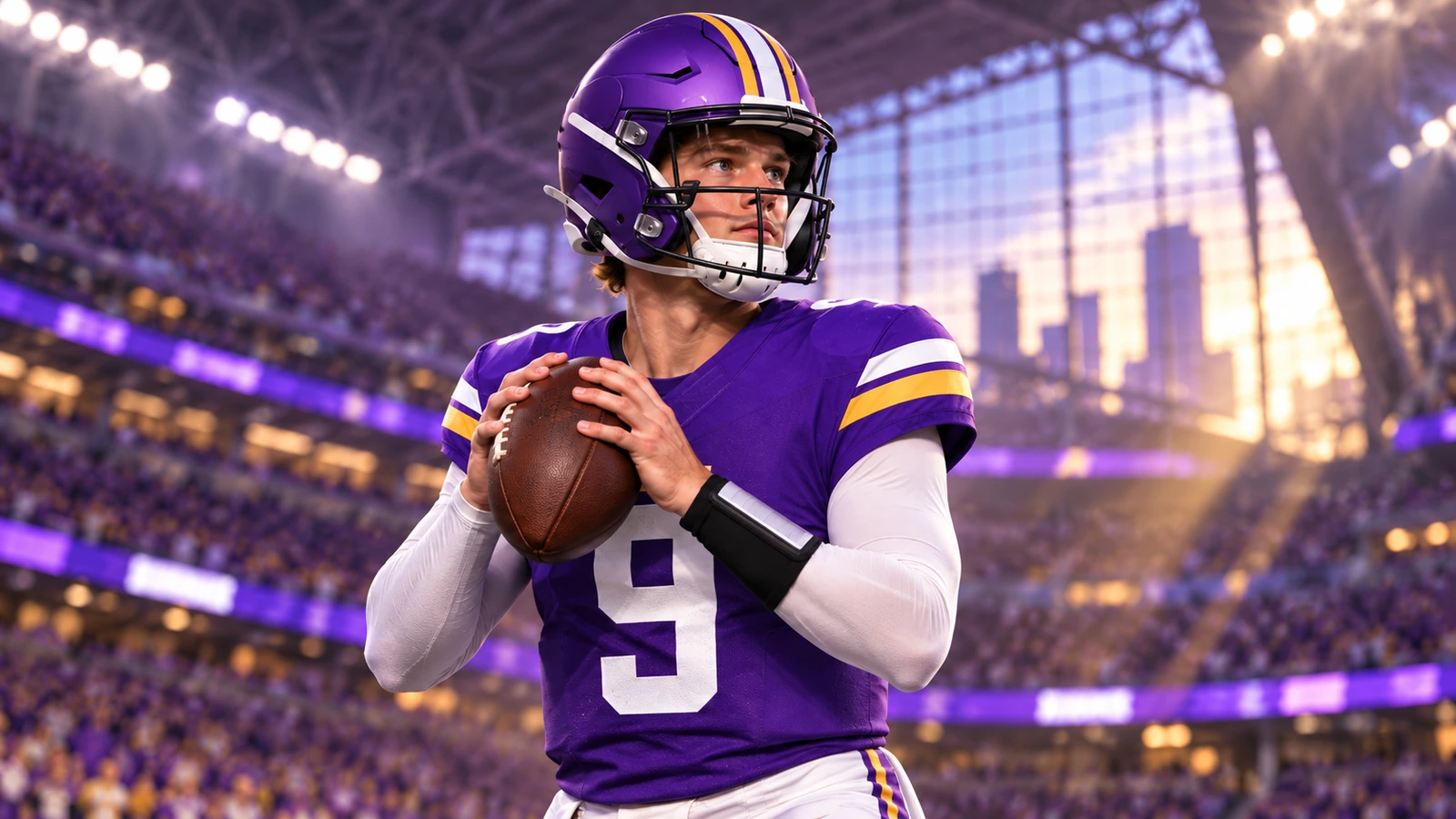

J.J. McCarthy is not opening the 2026 season as the Minnesota Vikings’ starting quarterback. He is not opening it as the backup, either.
Minnesota’s first regular-season depth chart lists Kyler Murray as the starter, Carson Wentz as the No. 2 and McCarthy behind both of them. Head coach Kevin O’Connell separately confirmed that Wentz will back up Murray against Green Bay and described the arrangement as a week-to-week decision. That qualifier matters. So does the depth chart itself.
For McCarthy, the No. 10 pick in the 2024 NFL Draft, QB3 is not a routine September label. It is the clearest sign yet that the Vikings have moved from building their quarterback plan around his development to making him earn his way back into it.
That does not mean Minnesota has abandoned a 23-year-old quarterback. O’Connell has continued to speak positively about McCarthy’s work, and the organization has publicly pushed back on the idea that third-string status automatically means he is leaving. But 2026 has become a crossroads season anyway. The question is no longer whether McCarthy will be handed the offense. It is whether he can force the Vikings to reconsider a hierarchy they deliberately built above him.
QB3 is the result of a two-year evaluation, not one bad week
McCarthy’s place on the depth chart looks dramatic because of where he started. Minnesota drafted him 10th overall in 2024 with the expectation that he could become its long-term answer after Kirk Cousins. A torn meniscus wiped out his rookie season before it began, delaying the evaluation by a full year.
When McCarthy finally got his opportunity in 2025, the results were mixed. He went 6-4 in 10 starts, and the Vikings’ own offseason review noted that he helped finish the season with four consecutive wins. There were real flashes of the traits Minnesota liked coming out of Michigan: movement ability, toughness, confidence late in games and enough arm talent to attack outside the structure of a play.
There was also enough inconsistency to keep the organization from treating those wins as proof that the quarterback question had been solved. McCarthy completed 57.6% of his passes for 1,632 yards, 11 touchdowns and 12 interceptions. Minnesota’s official training-camp preview noted that his 72.6 passer rating ranked last among qualifying quarterbacks in 2025.
Those numbers do not define a young quarterback forever. They do explain why the Vikings spent 2026 protecting themselves from another season in which their playoff hopes depend on McCarthy becoming reliable on a timetable the roster cannot control.
Kyler Murray changed the standard McCarthy had to meet
The most important offseason development was Minnesota adding Kyler Murray. The Vikings did not bring in an established former No. 1 overall pick merely to decorate the quarterback room. Murray and McCarthy split first-team opportunities during the offseason, but by August O’Connell had named Murray the starter.
That decision moved the competition from QB1 to the rest of the depth chart. Once Murray owned the starting job, the Vikings had to decide what they wanted from the player one snap away from the offense.
The answer, at least for Week 1, is experience.
Wentz enters the season with 99 career starts. He also has direct experience in O’Connell’s offense after starting five games for Minnesota last year before shoulder surgery ended his season. The Vikings know what it looks like when Wentz enters a game with limited preparation. That matters for a team that expects to contend in the NFC North immediately.
O’Connell’s explanation was revealing: a backup has to operate with limited repetitions while still carrying enough accumulated experience to execute the game plan. McCarthy may have more theoretical long-term upside than Wentz, but Minnesota is not using the QB2 job as a developmental award.
The Vikings are separating development from emergency readiness
This is the central idea behind McCarthy’s demotion. The Vikings can still believe in his development while believing Wentz gives them a better chance to survive a sudden in-game injury to Murray.
Those two ideas are not contradictory. They do, however, create a different kind of pressure for McCarthy.
As the starter in 2025, every live rep was part of his growth. As QB3, development becomes less visible and less forgiving. He has to improve through practice, meetings, scout-team work and a smaller collection of meaningful snaps. He must show the coaching staff that his processing, accuracy and command have advanced enough that experience is no longer the decisive advantage for Wentz.
O’Connell has emphasized that McCarthy is still preparing as though he could be needed. That is true in a literal sense: he is two injuries away from entering a game. But for a former top-10 pick, the more important competition now happens before Sunday. Every week is an opportunity to change the coaches’ answer to the question of who should be one snap from the offense.
McCarthy’s 2025 record is part of the argument, but not the whole argument
A 6-4 record in 10 starts makes it tempting to argue that McCarthy already proved enough to remain at least the backup. Team record alone cannot carry that case.
Minnesota is trying to evaluate whether its quarterback can consistently create efficient offense against NFL coverage, protect the football, handle pressure and keep the full playbook available. Those are repeatable skills. They matter more to long-term projection than whether a handful of close games broke in one direction.
McCarthy also deserves credit for the parts of 2025 that showed resilience. He returned from losing his entire rookie year, endured more injury disruption, and helped the Vikings finish with momentum. His rushing contribution — 181 yards and four touchdowns — gave the offense another dimension. The point is not that McCarthy failed. It is that the evidence remained incomplete.
Minnesota’s 2026 quarterback room is an attempt to stop incomplete evidence from becoming organizational risk.
This season now tests the Vikings’ original quarterback thesis
When a team spends a top-10 pick on a quarterback, it is making two bets. The first is on the player’s talent. The second is that the organization can develop that talent quickly enough to capture the roster-building value of a young quarterback contract.
McCarthy’s injury-shortened path has complicated the second bet. By the time the Vikings finally got a meaningful season of starts from him, the roster was too competitive to treat every mistake as a harmless investment in the future. Minnesota’s response was to add Murray and retain Wentz.
That changes the economics of the original plan even if McCarthy eventually rebounds. The Vikings no longer need to discover whether he can survive as an NFL starter. They need to discover whether he can become clearly better than the alternatives they can acquire.
That is a much higher bar, and it is the correct one for a franchise with Justin Jefferson, T.J. Hockenson and a defense built to win meaningful games now.
There is still a path back for McCarthy
The depth chart is not a permanent verdict. O’Connell explicitly called the backup arrangement week-to-week, and that gives McCarthy a practical target.
He does not need Murray to fail or Wentz to get hurt. He needs to make the coaches increasingly uncomfortable keeping him third.
That means cleaner practice tape. Faster decisions. More consistent ball placement. Better answers against pressure. Fewer plays in which athletic ability has to rescue an offense from a problem created before the throw. If those things show up consistently, the Vikings can move McCarthy to QB2 without changing their commitment to Murray as the starter.
From there, football can create opportunity quickly. Quarterback depth charts rarely remain untouched for an entire season. Murray has had injuries during his career, and Wentz has had his own availability issues. Minnesota is carrying multiple experienced options precisely because the team understands how quickly plans can change.
A trade is not the story yet
McCarthy’s demotion will naturally produce speculation about whether Minnesota should move him. That is getting ahead of the evidence.
The Vikings have publicly framed his role as continued development, not an exit plan. A young quarterback on a rookie contract still has value as depth and as a developmental asset, particularly when the starter is new to the organization. Minnesota does not need to turn a disappointing depth-chart position into an immediate transaction.
There is also no reason for the Vikings to make a long-term decision at the lowest point of McCarthy’s leverage. If his practice performance improves, his value to Minnesota improves. If another team suffers a quarterback injury later in the year, the market could change. If Murray plays at a high level and stays healthy, the Vikings gain more time to evaluate the room without forcing the issue.
The meaningful story is simpler: McCarthy has lost status inside the organization, and the next stage of his career depends on how he responds.
Week 1 against Green Bay makes the hierarchy real
The Vikings open against the Packers with Murray preparing as QB1, Wentz preparing as the immediate replacement and McCarthy preparing from the third spot. It is the first regular-season game in which that hierarchy stops being a camp storyline and becomes an operational plan.
For Minnesota, the arrangement is about maximizing its chance to win now. For McCarthy, it is about proving the story is not finished.
That distinction is why 2026 matters so much. The Vikings no longer owe McCarthy the starting job because of his draft position. They do not even owe him the backup job. What they owe him is a clear development standard and the opportunity to change their minds.
McCarthy now has to do the rest.