
















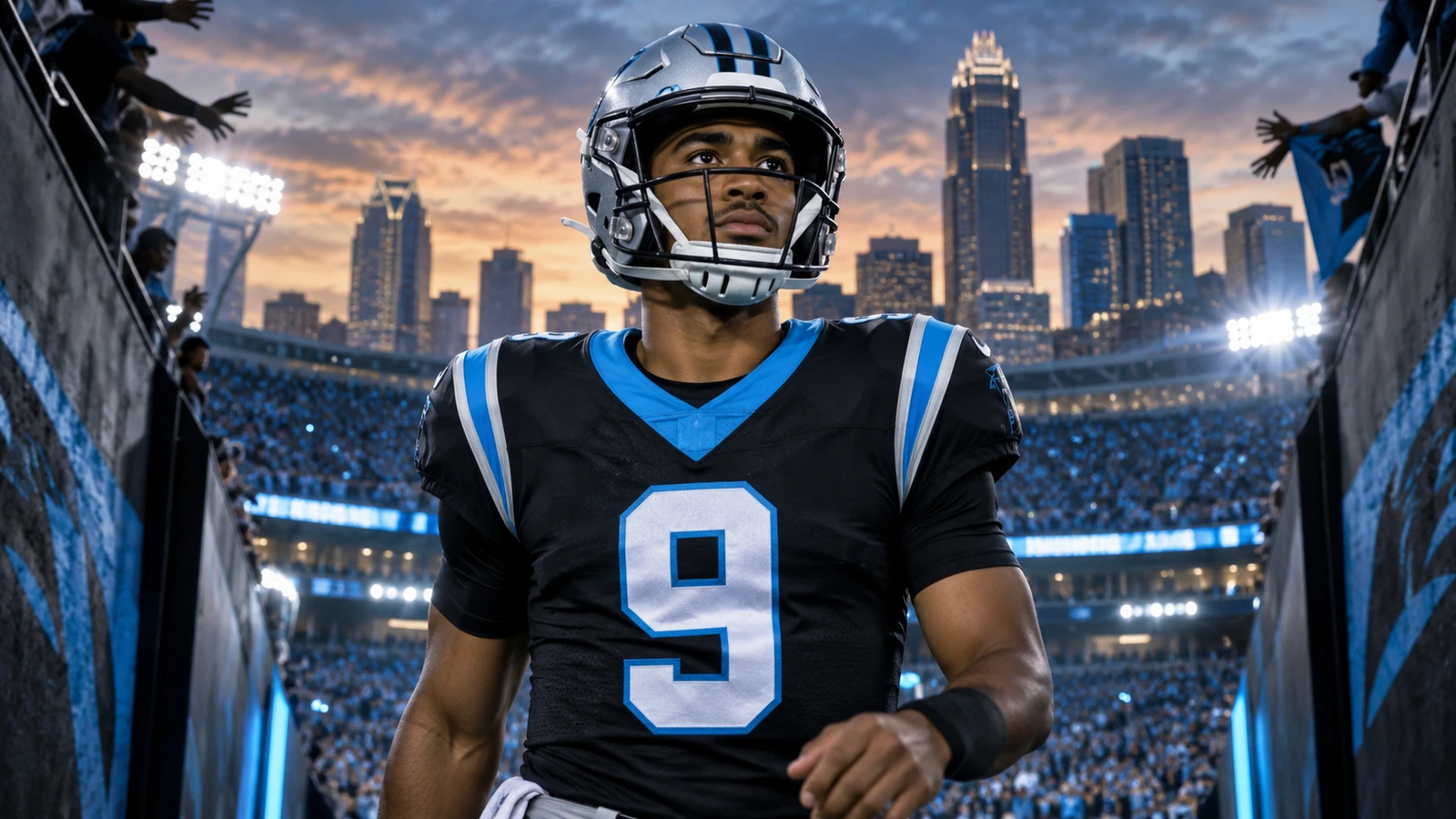

David Tepper did not announce a Bryce Young contract extension on Wednesday. He did something more revealing: he made clear that the Carolina Panthers still believe in their quarterback while refusing to pretend the organization has reached the final decision on what comes next.
During a rare football-focused media session, Tepper reiterated that Young has significant talent and can succeed with the right environment around him. Asked whether Carolina has offered the former No. 1 overall pick a new contract, however, the Panthers owner declined to say. Pressed on what would trigger an extension, Tepper eventually reduced the standard to a simple idea: success will be obvious when it arrives.
That combination of belief and restraint is the most important quarterback message Carolina has delivered entering the 2026 season. Young is not fighting merely to keep his job. The Panthers already exercised his fifth-year option for 2027, so the team retains contractual control beyond this season. The real question is whether 2026 becomes the year Carolina stops treating Young as a quarterback it is still evaluating and starts treating him as the quarterback around whom it is comfortable building the next half-decade.
The Panthers have moved beyond the original Bryce Young debate
The easiest way to misunderstand Young’s situation is to frame it as a replay of his disastrous rookie season. It is not. Carolina has already seen enough improvement to move beyond the question of whether he belongs in the league or can function as a starter.
Young helped the Panthers end a seven-year playoff drought in 2025, when Carolina won the NFC South despite finishing 8-9. That season did not make him an unquestioned top-tier quarterback, but it changed the organizational conversation. The Panthers were no longer asking whether they had to escape the Young era. They were asking how high the offense could climb if Young continued developing inside a more stable structure.
That matters because quarterback decisions become exponentially more expensive once they move from evaluation to commitment. The fifth-year option buys Carolina time. A long-term extension would spend some of that flexibility in exchange for cost certainty and organizational stability.
Tepper’s comments were supportive without removing the stakes
Tepper’s public stance is notable for what it did not do. He did not distance the organization from Young. He also did not use the media appearance to create artificial urgency around a contract.
That is a sensible position for Carolina. Young is under contract through 2027, and the Panthers do not need to negotiate against themselves before another full season of evidence arrives. At the same time, a strong 2026 could make waiting more expensive. Quarterback contracts rarely become cheaper once a player establishes himself as a stable playoff-caliber starter.
The Panthers therefore enter a useful but delicate window. They have enough control to be patient, but enough evidence to know that Young can materially change his market with another step forward.
Baker Mayfield just gave the NFC South a useful benchmark
The timing of Tepper’s comments is impossible to ignore because Tampa Bay just made its own long-term quarterback decision. The Buccaneers agreed to a three-year, $165 million extension with Baker Mayfield, a move FSN examined in depth in why Tampa Bay has made Mayfield its post-Tom Brady plan.
Young and Mayfield are not direct contract comparables. They are at different ages, arrived at their teams through different paths and have different bodies of work. But the Mayfield deal is a reminder of what happens when a franchise decides that quarterback uncertainty is more dangerous than quarterback expense.
Carolina does not need Young to copy Mayfield statistically. It needs him to create the same kind of organizational clarity. If the Panthers finish 2026 believing they can consistently win the division and contend in January with Young, the extension discussion changes from an abstract future question into a roster-planning priority.
What does Young have to prove in 2026?
The answer is more complicated than wins alone. Quarterbacks influence winning more than any other position, but no serious evaluation should treat a team record as a single-player statistic.
For Young, the most important evidence will come from repeatable offensive control. Carolina needs to see that he can generate efficient offense when the game script is not friendly, answer pressure looks without the staff constantly protecting him, create explosive plays without living on low-percentage throws and finish drives often enough that the Panthers are not asking their defense to win every close game.
There is also a durability component. The value of a long-term quarterback contract depends partly on the offense being able to build around a stable weekly presence. Carolina wants continuity at the sport’s most important position, not another cycle of short-term solutions.
Most of all, Young needs to show that the improvement of the last two seasons belongs to him as much as it belongs to circumstance. Dave Canales and the Panthers have worked to give him a healthier environment than the one he entered as a rookie. The next step is proving that Young can elevate that environment rather than merely function inside it.
Carolina has done more to support the evaluation
Tepper’s reference to the “right weapons” is important because quarterback evaluation is not conducted in isolation. The Panthers have spent multiple offseasons trying to make the offense more coherent around Young. The goal is to remove enough noise that the franchise can judge the quarterback rather than the dysfunction surrounding him.
That does not mean the supporting cast is perfect. Few rosters are. It means the excuses have narrowed. Young now has continuity in the offensive system, a front office that has invested around him and a coaching staff that understands how he plays best.
For Carolina, that makes 2026 valuable information even if the season is not perfect. The Panthers can study how Young responds when opponents have a full offseason of film on the current offense, how he adjusts when early game plans fail and whether he can win from the pocket when defenses take away his preferred answers.
The fifth-year option gives Carolina leverage, not certainty
Because Young is signed through 2027, there is no requirement that Carolina complete an extension this season. That leverage should prevent panic. It should not create complacency.
If Young breaks out in 2026, the Panthers may prefer to negotiate before another season increases the price. If he is merely adequate, Carolina can enter 2027 with more information and more flexibility. If he regresses significantly, the fifth-year option prevents the organization from having committed premium long-term money too early.
That range of outcomes is exactly why Tepper’s refusal to discuss an offer makes sense. The owner can believe in Young without announcing the result of an evaluation that the 2026 season is about to help complete.
Young’s contract question is really a franchise-direction question
The quarterback decision will shape every other major roster decision the Panthers make. A long-term extension affects cap allocation, draft priorities and how aggressively the front office can attack weaknesses elsewhere. It also signals to the locker room and the rest of the league that Carolina believes the rebuild has moved into a more stable phase.
That is why this season matters beyond Young’s individual statistics. If Carolina’s offense becomes dependable and the Panthers remain a legitimate NFC South contender, the front office can plan around an established quarterback instead of preserving resources for another search.
If uncertainty remains, the Panthers will have to keep one eye on alternatives even while Young remains under contract. That tension is expensive in its own way. Teams without conviction at quarterback often spend draft capital, cap space and coaching energy trying to solve the same problem repeatedly.
Week 1 starts the evidence-gathering process
Carolina opens against Chicago with a chance to begin the season from a very different place than the one Young inherited in 2023. The Panthers are defending division champions. Young is a team captain. The roster has been deliberately reshaped around a more stable football operation.
None of that guarantees an extension, and one game cannot settle a multi-year decision. But every meaningful snap now arrives inside a new context. Young is no longer trying to prove he deserves patience. He is trying to prove he deserves permanence.
The most important outcome is clarity
For years, the Panthers’ quarterback position created more questions than answers. Young’s development has finally given Carolina a chance to end that cycle on its own terms.
Tepper’s comments did not promise a deal, nor should they have. They confirmed that the owner still sees the talent that led Carolina to draft Young first overall, while leaving the next contract to be earned by what happens on the field.
That makes 2026 one of the most important Panthers seasons in years. A strong campaign would not simply produce another playoff chase. It could give Carolina the conviction to lock in the quarterback around whom the franchise has spent three years rebuilding.
Young has already changed the question from “Can he recover?” to “How far can he take them?” If the answer becomes clear enough this season, the Panthers’ next major quarterback decision may finally be about extending a window instead of starting over.