
















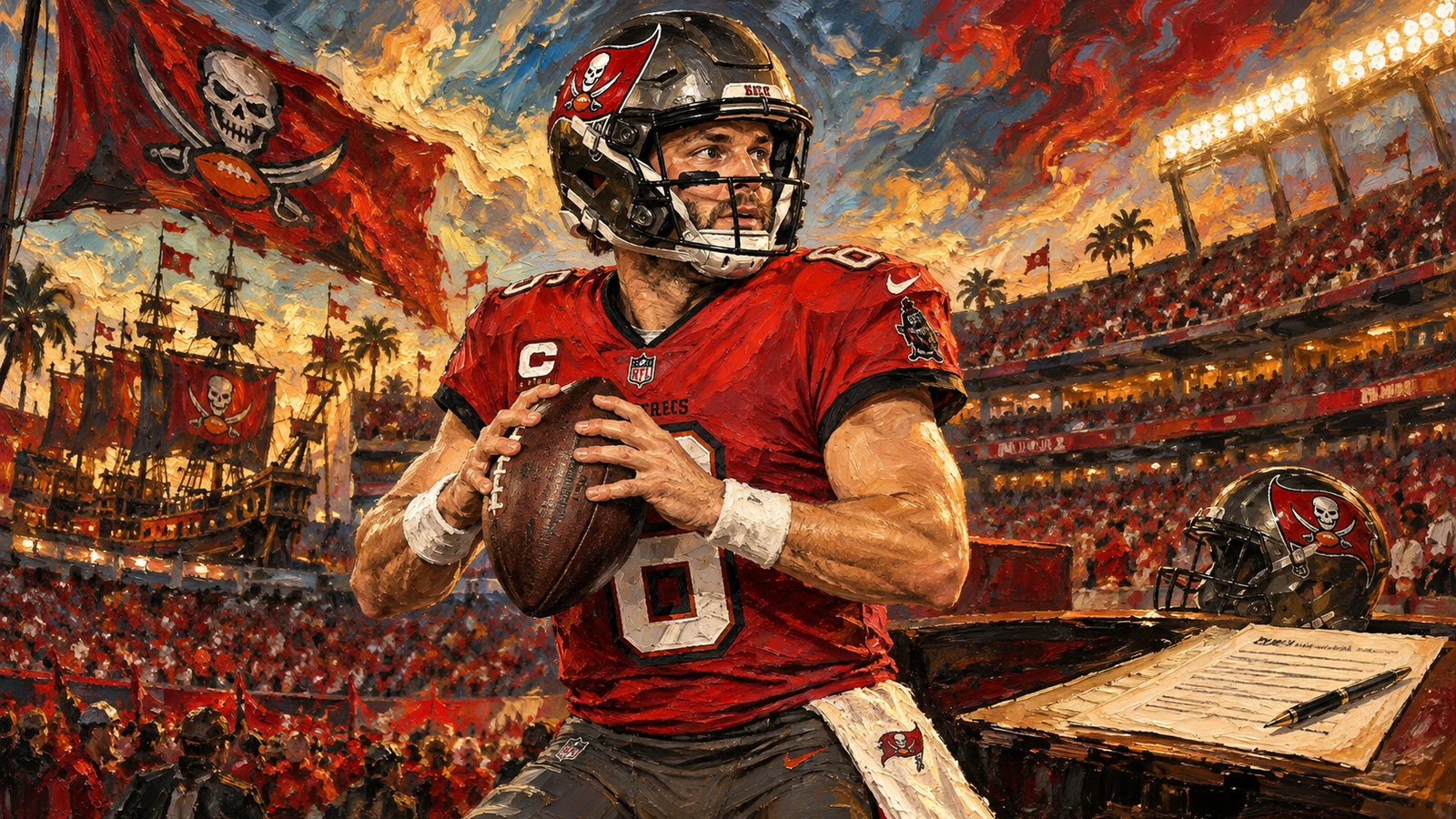

The Tampa Bay Buccaneers did not merely give Baker Mayfield another contract. They answered the biggest organizational question that has followed them since Tom Brady retired: who is the quarterback around whom the next version of the franchise will actually be built?
On the eve of the 2026 season, Tampa Bay agreed with Mayfield on a three-year, $165 million extension that keeps him under contract through 2029. The new years average $55 million, and the Buccaneers say the agreement makes Mayfield the highest-paid player in franchise history. It is an enormous commitment to a quarterback who arrived in Tampa three years ago as a former No. 1 pick trying to stabilize a career that had already carried him through Cleveland, Carolina and Los Angeles.
That path is what makes the contract more important than its headline number. Mayfield was supposed to help Tampa Bay navigate life after Brady. Instead, he played well enough to become the identity of that life. The Buccaneers have now moved from taking a low-risk chance on Mayfield, to rewarding his first successful season, to making him the long-term centerpiece of their roster. For the Buccaneers, the bridge quarterback has become the plan.
Mayfield turned a temporary answer into a franchise decision
Tampa Bay’s bet is supported by three seasons of production rather than one hot stretch. The Buccaneers say Mayfield ranks second in the NFL with 95 touchdown passes and third with 12,237 passing yards from 2023 through 2025. He helped deliver two division titles during that span and gave the offense a level of continuity that was far from guaranteed when he first signed after Brady’s retirement.
The individual seasons tell the same story in different ways. Mayfield threw for 4,044 yards and 28 touchdowns in 2023, followed that with 4,500 yards and 41 touchdowns in 2024, then produced 3,693 yards and 26 touchdowns in 2025. The final year was not the clean upward step Tampa Bay would have preferred. The team finished 8-9 and missed the playoffs after an encouraging start, which makes the timing of the extension more revealing. This is not a franchise reacting to a perfect season. It is a franchise deciding that the larger three-year sample matters more than one disappointing finish.
That distinction is important. Teams get into trouble when they pay a quarterback because they are afraid of the alternative. Tampa Bay’s case is stronger than that. Mayfield has already shown that the offense can function at a high level with him as the starter, that he can carry a large portion of the passing burden and that his personality fits the organization. The Buccaneers are paying for continuity they have tested, not continuity they are imagining.
The contract closes the door on the “bridge quarterback” label
Mayfield’s first Tampa Bay contract could still be understood as a rehabilitation story. His next deal, a three-year pact worth $100 million after the 2023 season, rewarded the turnaround but left another major decision approaching. The 2026 season would have been the final year of that contract. Without an extension, every losing streak, injury and roster decision could have become part of a running debate about whether Tampa Bay should start over at quarterback in 2027.
The new deal changes that framing. Mayfield is now signed through 2029, giving the Buccaneers a defined quarterback timeline for the next several roster cycles. Draft decisions, veteran contracts and offensive development can be made with a known starter instead of with a looming vacancy at the sport’s most important position.
FSN’s recent analysis of Jalon Daniels winning Tampa Bay’s QB2 job argued that the backup competition was about supporting Mayfield, not quietly launching a succession plan. The extension makes that point explicit. Daniels and the rest of the quarterback room can now be evaluated in the proper context: Tampa Bay has a starter, and the organization has paid him like one.
Why Tampa Bay made the deal despite a disappointing 2025 finish
The simplest answer is that quarterback stability is expensive because instability is worse. Tampa Bay could have let Mayfield play out 2026 and tried to renegotiate later, but that would have introduced several forms of risk. A strong season could have made him more expensive. A contract-year distraction could have lingered over the team. And a breakup would have sent the Buccaneers into the draft, free agency or the trade market searching for a replacement with no guarantee of finding one.
The sides also had some negotiating scar tissue. Reports said Mayfield was unhappy with proposals before his self-imposed training-camp deadline passed without a deal. Reaching an agreement roughly six weeks later suggests both sides eventually decided the relationship was more valuable than the leverage battle. Tampa Bay got long-term certainty. Mayfield got a contract that places him among the league’s highly paid veteran starters and recognizes what he has become for the franchise.
That does not mean every contract detail should be treated as fully settled publicly on signing night. Reports can describe guarantees differently depending on whether they are discussing new guarantees, total guarantees or money already secured under the previous contract. The clearest confirmed headline is the three-year, $165 million extension and the $55 million average on the added seasons. The larger cap accounting can be judged more precisely once the full structure is processed and reported.
The extension raises the standard around Mayfield
Security removes one kind of pressure and creates another. Tampa Bay is no longer evaluating whether Mayfield is good enough to keep. It is now evaluating whether the team around an expensive veteran quarterback is good enough to contend. That shifts scrutiny toward roster construction, offensive line performance, the development of younger skill players and the coaching staff’s ability to keep the offense efficient as personnel changes over time.
This is the normal life cycle of a successful quarterback rehabilitation story. The bargain phase ends. The quarterback’s contract begins to consume the kind of resources that force harder decisions elsewhere. The franchise must find value in the draft, avoid paying for reputation at too many other positions and keep creating inexpensive contributors who can grow alongside the established core.
Mayfield’s contract therefore should not be read as Tampa Bay declaring the roster finished. It is the opposite. The deal establishes the quarterback cost around which the rest of the roster must now be engineered. The front office has chosen certainty at quarterback; its next challenge is making sure that certainty does not turn into rigidity everywhere else.
Mayfield has become part of the Buccaneers’ identity
There is also a less mathematical reason the extension makes sense. Mayfield’s edge, competitiveness and willingness to play through difficult stretches have become part of the public face of the team. The Buccaneers’ ownership called him the unquestioned leader of the franchise when announcing the agreement. That is not a throwaway phrase when attached to the largest contract in team history.
Quarterback leadership is easy to romanticize, but it has practical value when a franchise is trying to avoid constant resets. Coaches can install with continuity. Receivers can develop timing with the same passer. The locker room knows who owns the huddle. The front office knows which quarterback traits it is trying to complement. None of those things guarantee wins, but changing quarterbacks usually forces a team to re-answer all of them at once.
Mayfield has already survived enough career instability to understand the difference. Tampa Bay does too. The Buccaneers are choosing to keep the one piece of their post-Brady transition that has consistently worked.
What this means for 2026
The extension does not erase last season’s 8-9 record or lower the urgency around 2026. If anything, it removes the contract as an explanation. Mayfield and the Buccaneers can enter the season without a lame-duck storyline at quarterback, and the organization can evaluate the team on football terms: can the offense rebound, can the roster stay healthy, and can Tampa Bay return to the postseason?
There is value in settling the question before the games start. A team with a veteran quarterback in the final year of his contract can spend months debating the future every time the standings change. Tampa Bay has chosen not to live that way. The result is clarity, but clarity brings accountability. Mayfield is being paid to anchor the next phase, and the roster is being built with the assumption that he is good enough for that phase to matter.
The post-Brady era finally has its own quarterback
For three years, the easiest way to describe the Buccaneers was as a team trying to remain competitive after Brady. That framing is now outdated. Brady’s departure explains how Mayfield arrived, but it no longer explains why he is here. Ninety-five touchdown passes, more than 12,000 passing yards and two division titles are Mayfield’s résumé in Tampa, not an extension of someone else’s era.
The $165 million extension makes the organizational transition official. Tampa Bay is not waiting for a different quarterback to define the next chapter. It is betting that Mayfield already has. The contract could ultimately look like smart continuity or an expensive ceiling on a team that needs to take another step, but at least the decision is no longer ambiguous. The Buccaneers know who they are building around through 2029. Readers can follow the larger roster and division picture through FSN’s NFL coverage hub.
That is why this is bigger than a contract story. The money tells us what Mayfield is worth to Tampa Bay. The timing tells us what the Buccaneers believe about themselves. After three seasons of treating him as the answer in practice, they have finally made him the answer on paper.