
















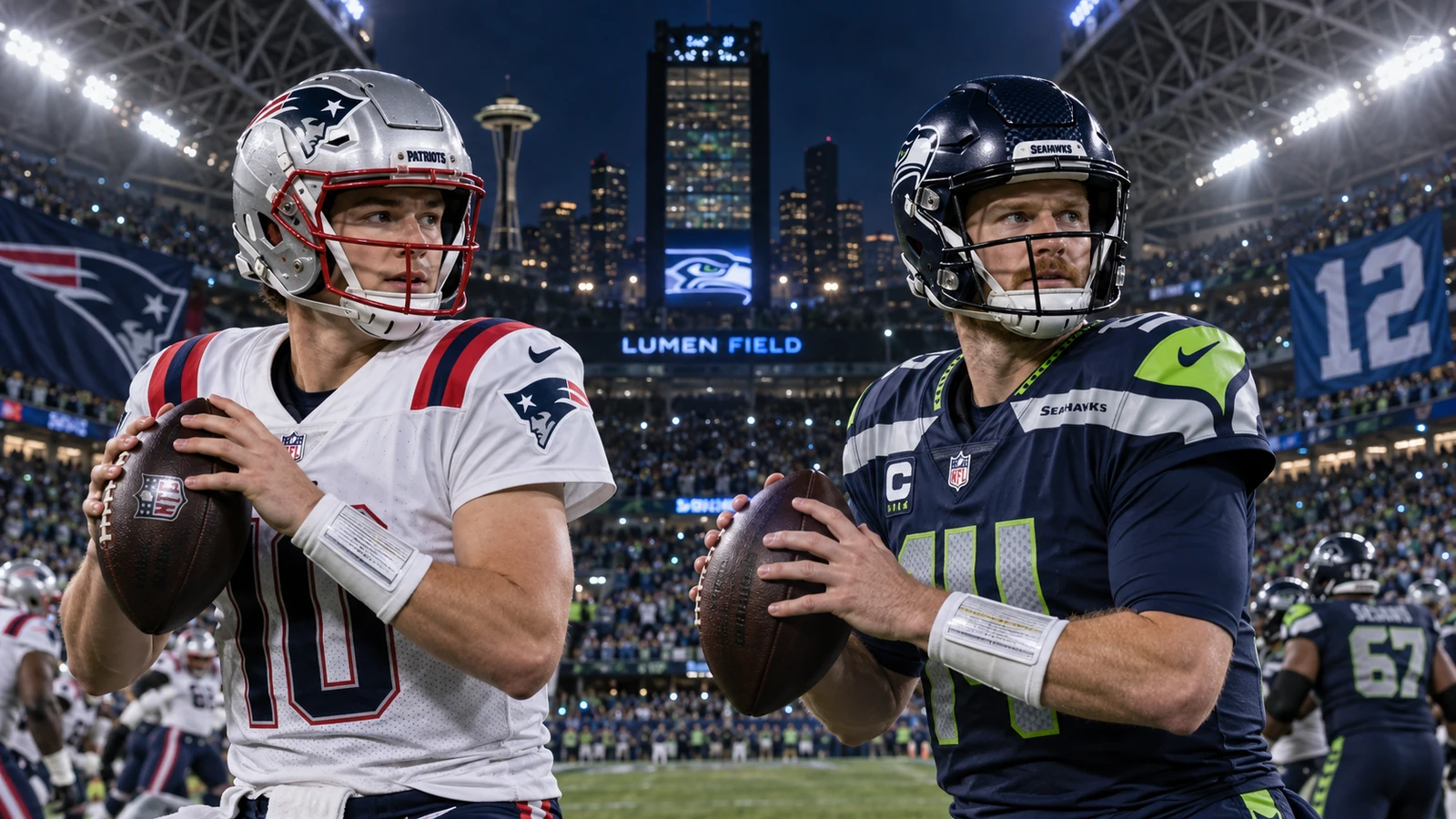

The 2026 NFL season opens Wednesday night in Seattle with an unusually clean test of offseason progress. Seven months after the Seahawks beat the Patriots 29-13 in Super Bowl LX, New England returns to Lumen Field for a Week 1 rematch against the team that ended its championship run. The banners, the television window and the revenge language will make the game feel like a continuation of February. The more useful way to view it is as a reset: two contenders with much of the same foundation, but enough important changes to ask whether the gap between them has moved.
The league has not opened a season with a Super Bowl rematch since Denver hosted Carolina in 2016. This one arrives with even more symmetry because the central figures remain in place. Drake Maye is still driving New England’s offense. Sam Darnold remains Seattle’s quarterback. Mike Vrabel and Mike Macdonald still define the identities of their teams. Yet the details around those pillars have shifted, and Week 1 will immediately force those changes into the brightest possible environment.
For the Patriots, the question is whether another offseason of investment around Maye has turned a Super Bowl participant into a more complete championship team. For the Seahawks, the challenge is different: can a defending champion absorb the inevitable losses that follow a title run without losing the style that made it dominant?
The rematch matters because the core of both teams is still recognizable
Seattle’s own Week 1 coverage notes that the Seahawks return 20 of the 22 starters who opened Super Bowl LX. That is a remarkable amount of continuity for a champion and one reason the matchup should not be framed as a completely new Seattle team. The defense that frustrated New England still has Macdonald’s structure behind it. Darnold and Jaxon Smith-Njigba remain central pieces of the offense. The broad identity is intact.
New England is similarly recognizable where it matters most. Maye is entering his third season after leading the Patriots through an AFC title run. Vrabel is still setting the physical, situational tone. And the defense enters the year with Christian Gonzalez no longer carrying a contract cloud after FSN’s coverage of his record-setting extension. That matters because elite coverage talent is particularly valuable against a Seattle offense built around winning difficult one-on-one situations outside.
Continuity, however, does not mean stasis. Seattle lost Super Bowl MVP Kenneth Walker III in free agency and is handing offensive play-calling to Brian Fleury after Klint Kubiak’s departure. New England has also worked to add more help around Maye. The matchup therefore becomes a useful comparison between two different kinds of continuity: Seattle is trying to preserve a championship machine after losing pieces from it, while New England is trying to improve a machine that reached the final game but could not finish the job.
Seattle’s biggest question is what its offense looks like without Kenneth Walker
The most visible offensive change for the Seahawks is the absence of Walker. His departure is not simply a depth-chart transaction because he was the Super Bowl LX MVP and a central part of the physical balance that made Seattle difficult to defend. The Patriots cannot assume the Seahawks will reproduce that exact formula with a different backfield, but they also cannot build the game plan around the idea that Seattle’s rushing threat disappeared with one player.
Fleury’s first regular-season game as offensive coordinator adds another variable. Seattle promoted continuity as an important part of the transition, but a new play caller inevitably reveals preferences. How often does Seattle lean on early-down runs? How aggressively does it move Darnold? How does it manufacture touches when the Patriots take away the first read? Those are not questions New England could answer from February tape.
This is where Week 1 uncertainty cuts both ways. The Patriots know the Seahawks’ personnel and broad defensive philosophy extremely well after preparing for them on the sport’s biggest stage. Seattle knows New England just as well. But both staffs have had seven months to study what the opponent attacked, what failed and where counters might now exist. The opening quarter could look less like a replay of the Super Bowl and more like a chess match between two staffs that already know the obvious answers.
Drake Maye has to show that the Super Bowl loss taught New England something
The rematch will naturally be reduced to quarterback results, but the more interesting evaluation is how Maye manages Seattle’s pressure and coverage structure. Super Bowl losses often create exaggerated offseason narratives. A young quarterback either gets labeled as the next inevitable champion or as someone who was exposed. Neither framing is useful. Maye’s real task is narrower and harder: process the same defense more cleanly, identify where Seattle is changing the picture and avoid allowing frustration to turn into negative plays.
That becomes more difficult because New England will not have its full offensive backfield. TreVeyon Henderson is out with an ankle injury after missing all three practices during game week. Center Ben Brown is also out, while Christian Barmore is cleared to play on defense. Henderson’s absence pushes more responsibility toward Rhamondre Stevenson and the rest of the Patriots’ available backs, but it also affects the passing game because Henderson’s speed and receiving value can change how linebackers and safeties fit a formation.
New England does not need Maye to produce a statistical masterpiece to prove progress. It needs the offense to stay on schedule against a defense that thrives when opponents fall behind the sticks. That means protecting the football, avoiding drive-killing sacks and creating enough explosive plays to prevent Seattle from compressing the field. If the Patriots can do those things, the rematch starts to look less like a revenge game and more like evidence that the offense learned from February.
The Seahawks defense still gives the matchup its shape
Seattle won the Super Bowl because it controlled the terms of the game, and Macdonald’s defense remains the clearest reason to believe the champion can begin 2026 at the same level. The challenge for New England is not merely beating individual defenders. It is identifying the leverage Seattle is trying to create before the snap and then surviving the late movement that changes the picture.
The Seahawks are not perfectly healthy in the secondary. Safety Ty Okada is out, while Nick Emmanwori is questionable with an ankle issue. Wide receiver Tory Horton is also questionable. Those designations matter, but they do not change the central expectation: Seattle will still try to make Maye hold the ball, force the Patriots to string together long drives and turn one mistake into a field-position swing.
For Gonzalez and the Patriots defense, the assignment is almost the mirror image. Smith-Njigba remains the obvious receiving focal point, and Darnold proved last season that he could function efficiently inside Seattle’s system. New England’s best path is to make the new backfield and new play-calling structure prove themselves immediately rather than allowing Darnold to live in favorable down-and-distance situations.
This is a better measuring stick than a normal Week 1 game
Week 1 conclusions are usually dangerous. Teams are still discovering how much of their preseason plan survives contact with real opponents. Conditioning, communication and timing can distort early results. One game will not tell us which team is better over a 17-game season.
This matchup is still unusually informative because the comparison point is so recent. Seattle and New England are not meeting after years of roster turnover. They are meeting seven months after a championship game with the same head coaches, the same starting quarterbacks and many of the same core players. When something looks different Wednesday night, there is a reasonable chance it reflects an intentional offseason adjustment rather than random year-to-year noise.
If New England protects Maye better, creates cleaner answers against Seattle’s pressure looks and holds up without Henderson, that will matter. If Seattle’s new offensive coordinator immediately preserves the balance and efficiency that carried the team through last season, that will matter too. The value is not in declaring a September champion. It is in identifying which offseason ideas actually survived their first serious test.
What a Patriots win would mean
A New England victory would not erase Super Bowl LX. It would do something more practical: show that the Patriots can walk back into the environment where Seattle is celebrating a title, handle the emotional noise and solve enough of the same football problems to win. For a team trying to prove last year’s run was the beginning of a window rather than the peak of one, that would be a meaningful opening statement.
It would also strengthen the case that New England’s roster construction around Maye and Gonzalez is working. The Patriots have committed premium resources to keeping a young defensive cornerstone and building an offense capable of surviving elite opponents. Beating the defending champion on the road would not validate every decision, but it would provide the kind of high-end result contenders collect when their trajectory is moving in the right direction.
What a Seahawks win would mean
For Seattle, the task is less about proving the Super Bowl was real and more about proving the standard survived the offseason. Macdonald has pushed the idea of starting from the bottom again rather than treating the championship as something the 2026 team automatically inherits. That mindset is easy to repeat in May. It becomes real when the banner is raised and the opponent from the Super Bowl is standing across the field.
A clean Seahawks win would suggest that losing Walker and changing offensive coordinators did not immediately destabilize the formula. It would reinforce the value of returning so many starters and make Seattle look less like a defending champion living off last season and more like a team already building the next version of itself.
The Week 1 stakes are real even if the conclusions must stay measured
FSN’s Week 1 confidence pool page treats the game as one part of a full opening slate. From an editorial standpoint, though, no other Week 1 matchup offers this exact combination of recent history and immediate strategic comparison. The league gets its spectacle. The teams get something more useful: a high-quality answer to whether their offseason work moved them forward.
That is why the rematch should be watched through a wider lens than revenge. Seattle already has the trophy. New England cannot take it back. What the Patriots can do is show that the version of their team entering 2026 is better prepared for the problems that stopped them in February. What the Seahawks can do is show that the championship identity still works after the inevitable churn of an NFL offseason.
By the time the banner ceremony fades and the first real series begins, the past will matter mostly because it gives us a baseline. The game itself is about the future. Two contenders enter with familiar quarterbacks, familiar coaches and familiar ambitions. The team that looks more evolved on Wednesday night will leave with something more useful than a symbolic rematch win: the first credible evidence that its 2026 plan is already working.