
















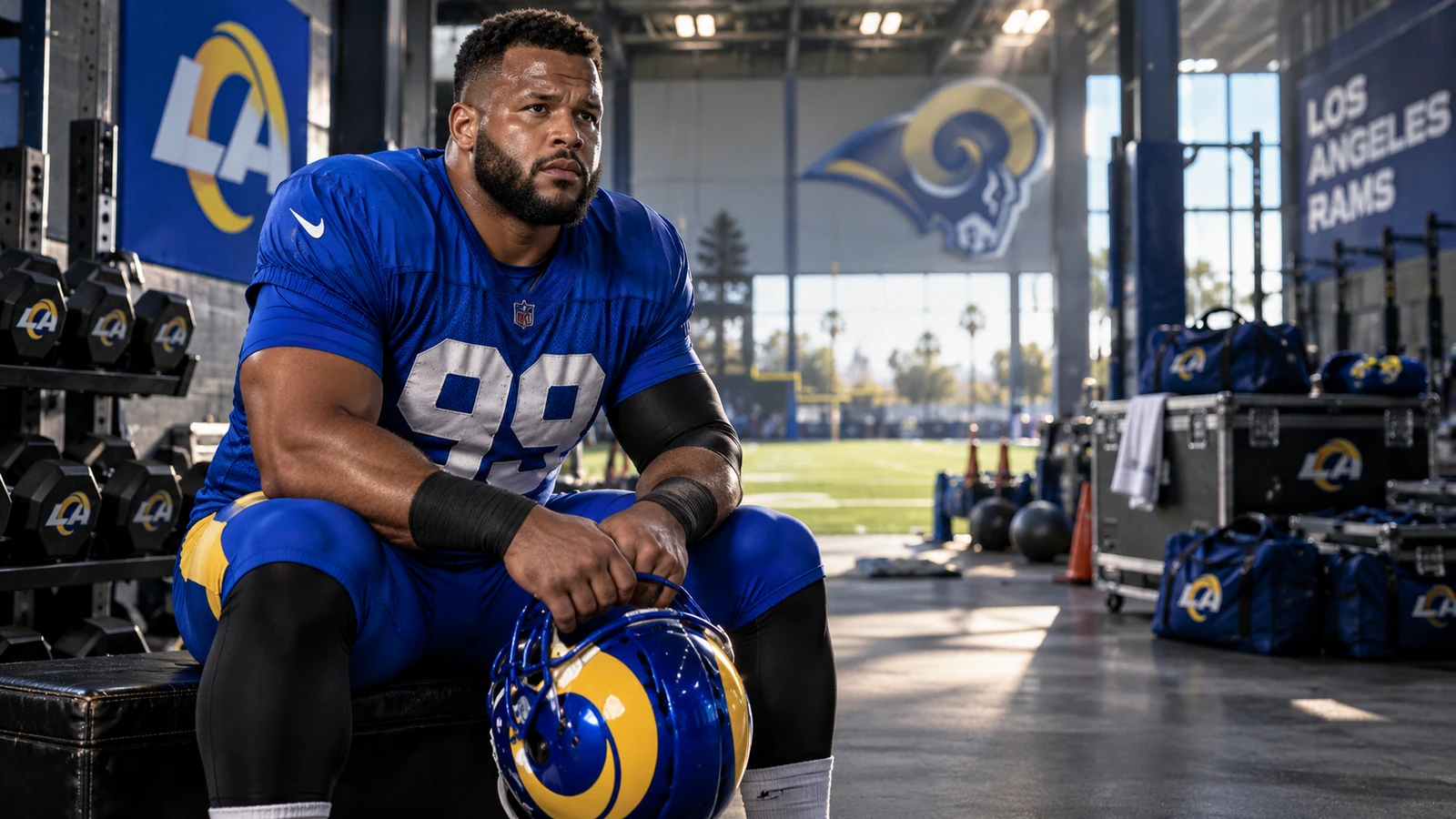

Aaron Donald’s comeback will not begin in Melbourne. Los Angeles Rams coach Sean McVay said Tuesday that Donald will not play in the team’s Week 1 opener against the San Francisco 49ers and will not travel to Australia. The decision ends the uncertainty that followed Donald through opening week and pushes his first NFL snap since the 2023 season to at least Week 2.
The news is a meaningful update to FSN’s recent coverage of Donald’s return and the Rams’ aggressive Super Bowl push. The larger thesis of that comeback has not changed: Los Angeles still added an all-time interior defender to a front that already includes major star power. What changed Tuesday is the timetable. The Rams will begin the season without Donald rather than forcing a 35-year-old who only officially unretired on Aug. 30 into an international opener.
Why the Rams are holding Aaron Donald out
McVay characterized the decision as what the Rams believe is best for both Donald and the team, while also saying he expects the veteran to be ready sooner rather than later. That framing matters. Los Angeles did not announce a new injury or a setback that changes the entire comeback story. Instead, the club appears to be managing the ramp-up of a player who has been away from regular-season football for two full seasons and rejoined the roster less than two weeks before the opener.
An overseas game adds another layer. The Rams and 49ers are playing the league’s first regular-season game in Australia at the Melbourne Cricket Ground. With travel, time-zone adjustment and game preparation compressed into an unusual week, Los Angeles had to decide whether Donald’s first test back should happen under the least normal Week 1 circumstances possible. It chose patience.
Los Angeles can afford to be patient because the front is deep
The easiest way to understand the decision is to look at the defensive line McVay cited when discussing it. The Rams still expect to rotate Kobie Turner, Braden Fiske, Poona Ford, Tyler Davis and Ty Hamilton inside. That group gives Los Angeles enough functional depth to avoid treating Donald’s return as an emergency solution.
More importantly, Myles Garrett is expected to play. McVay said the star edge rusher will be ready to go after his own managed summer. That means the Rams will still put a premier pass-rush threat on the field against San Francisco even with Donald staying home. The long-term attraction remains obvious: if Donald gets up to speed, Los Angeles eventually can combine his interior disruption with Garrett’s edge pressure and a young group that does not need either veteran to play every snap.
For the Rams, that is the key difference between adding Donald in 2026 and asking him to recreate his old workload. This comeback can be additive. Los Angeles does not need to build the defense around Donald from Day 1; it needs to find the right role and snap volume that makes the entire front harder to block over a long season.
What Donald’s absence changes against the 49ers
San Francisco gets an immediate tactical break. Interior pressure is one of the fastest ways to damage an offense because it can collapse the pocket before route concepts develop and can force quarterbacks off their launch point. Donald has built a Hall of Fame-level career on doing exactly that. Removing him from the opener means the 49ers can prepare for a Rams front that is still dangerous but less exotic than the version Los Angeles hopes to deploy later.
The game is not short on comeback storylines. San Francisco has confirmed that Nick Bosa is expected to play after his own long recovery from a knee injury. George Kittle also traveled to Australia and has been working toward availability after his Achilles injury. That makes the opener a strange collision of championship-level veterans at different stages of return: Bosa is expected to be active, Kittle is trending toward it, and Donald will wait.
The Rams are protecting the season, not just Week 1
Donald has nothing left to prove about his ability at his peak. The 2026 question is whether he can become an efficient high-impact piece after two seasons away. That makes early-season workload management more important than symbolic participation in the opener. A limited Donald in Melbourne would create a huge television moment, but the Rams’ actual objective is to have him useful when the schedule gets deeper and the games become more consequential.
McVay’s comments leave the door open for a relatively quick debut, but they do not guarantee a Week 2 return. NFL.com pointed to the next game against the Giants as the earliest obvious target. The sensible reading is that Los Angeles will continue evaluating Donald’s conditioning and practice response rather than locking itself into a public date.
What comes next for Aaron Donald
Donald will stay back while the Rams travel to Australia. The rest of the defense will face a 49ers offense trying to get healthy at the same time, and Los Angeles will get its first data point on how the front functions with Garrett available but Donald not yet in the rotation. Fans tracking the opener can also compare the matchup with FSN’s Week 1 confidence rankings.
The most important takeaway is that Donald’s comeback has been delayed, not derailed. The Rams’ Super Bowl bet remains aggressive, and the eventual pairing of Donald and Garrett remains one of the most fascinating defensive experiments of the season. It just will not debut on the league’s new stage in Melbourne.
For Week 1, Los Angeles is choosing the long view. Given Donald’s age, the length of his layoff and the depth around him, that may be the more consequential decision than forcing one more star into an already spectacular opener.