
















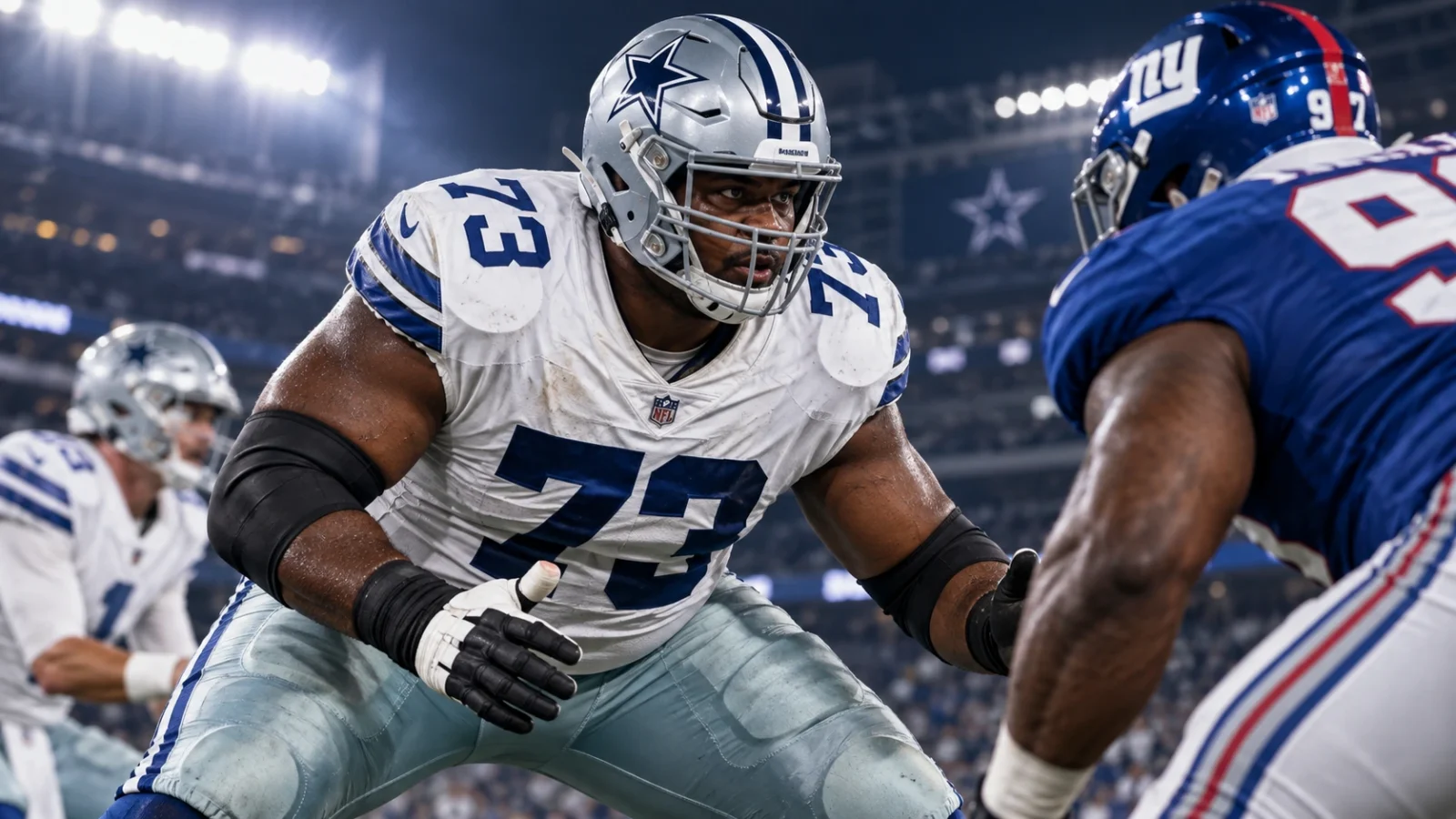

The Dallas Cowboys will open the 2026 season without one of the most important players on their offense. All-Pro guard Tyler Smith is set to undergo thumb surgery and is expected to miss four to six weeks, forcing Dallas to turn to T.J. Bass at left guard just as the regular season begins.
Head coach Brian Schottenheimer said Smith had been dealing with the thumb issue and reached the point where he could no longer perform at the level required of an NFL offensive lineman. Dallas plans to place him on injured reserve with a designation to return, which means he must miss at least four games. The earliest realistic return point is Week 5 against Tampa Bay.
The timing is painful because the Cowboys had navigated training camp and the preseason without a major injury to their core. But the decision also reflects a longer view. Rather than ask Smith to play through a grip-strength problem that could compromise both his technique and effectiveness, Dallas is choosing to fix the injury now and preserve the rest of his season.
Why Tyler Smith’s absence matters so much
Smith is not simply another starter in the Dallas lineup. He has developed into one of the league’s best interior linemen after entering the NFL as a first-round pick in 2022. He has made the Pro Bowl in three straight seasons and has been a stabilizing force while the Cowboys reshaped the rest of their offensive line around him.
That stability is especially valuable at guard, where Smith’s power and athleticism help Dallas in both the run game and pass protection. Interior disruption can ruin an offense quickly because pressure arrives directly in a quarterback’s face. For Dak Prescott, losing a high-level guard means the pocket geometry changes even if the replacement performs competently.
Smith’s durability also made him easy to take for granted. He has played at least 16 games in three of his first four NFL seasons. Dallas has been able to build weekly plans assuming he would be available. For at least the first month of 2026, that assumption is gone.
Why Dallas is confident in T.J. Bass
The Cowboys’ response has been consistent: they believe Bass is ready. Schottenheimer said the team has a “ton of confidence” in him, and that confidence is backed by actual experience rather than preseason optimism. Bass has 10 career starts, including five in 2025, and has already played next to center Cooper Beebe and tackle Tyler Guyton.
That familiarity matters. Offensive line play is collective. Communication on twists, games, blitz pickups and run fits often matters as much as individual talent. Bass is not entering a foreign group. He has practiced in this system, taken first-team reps during camp when Dallas managed Smith’s workload and played beside the linemen who will surround him now.
Dallas also protected Bass in the offseason with a second-round tender, a clear sign that the organization viewed him as more than disposable depth. According to the Cowboys, Bass logged 198 pass-blocking snaps last season and allowed eight quarterback pressures with no sacks. That was the lowest pressure total among Dallas linemen with at least 190 pass-blocking snaps.
Those numbers do not make him Tyler Smith. They do explain why the Cowboys are not panicking.
The Week 1 test arrives immediately against the Giants
The problem for Dallas is that the schedule does not offer a soft transition. The Cowboys open Sunday night against the New York Giants, a divisional opponent with the type of defensive front that can attack a new interior combination from the opening drive.
That puts Bass under immediate pressure, but it also changes the burden on the rest of the Cowboys offense. Dallas can help by using tempo, play-action, screens and quick throws to prevent the Giants from repeatedly isolating the replacement guard in obvious passing situations. The run game can help too, but only if the line establishes enough movement to keep the offense ahead of the sticks.
The most important question is not whether Bass can impersonate Smith. He cannot, and Dallas should not ask him to. The question is whether the entire offense can function normally enough that Smith’s absence does not become the defining feature of the first month.
Dallas faces a difficult four-game stretch without Smith
The schedule makes the timing even more important. After the Giants, the Cowboys face Washington, Baltimore and Houston before Smith is eligible to return. Those defenses present different challenges, but none are the kind of matchup where a weakened interior line can be ignored.
Dallas therefore needs Bass to be steady rather than spectacular. The Cowboys can survive a month without one elite lineman if the replacement avoids catastrophic mistakes and the rest of the unit remains healthy. What they cannot afford is compounding the loss with communication breakdowns, penalties or additional injuries.
That is also why the timing of the surgery makes sense. Playing through the injury might have kept Smith on the field in name only while reducing his ability to anchor, strike and control defenders with his hands. For an offensive lineman, thumb and hand function are not peripheral. They are central to nearly every snap.
The injury creates a depth test for the entire roster
Smith’s move to injured reserve will create an open roster spot, and Dallas has options for how to fill it. Practice-squad lineman Nick Leverett is one candidate because of his guard-center versatility. The Cowboys may also choose to use the spot elsewhere while elevating interior depth on game day as needed.
The broader point is that this is the type of injury that tests roster construction. The best teams do not simply collect starters; they create credible answers behind them. Bass was retained precisely for a moment like this. Dallas believed he was worth protecting even though Smith blocked his path to a full-time starting role.
Now the Cowboys get to find out whether that investment was enough.
Why the long-term outlook is better than the short-term headline
The immediate news is negative, but Dallas does have reason to avoid worst-case thinking. The expected recovery timetable is measured in weeks, not months, and the Cowboys believe Smith can return during the first half of the season. Jerry Jones said Tuesday that the injury had reached the point where internal fixation was the right long-term solution.
If the procedure works as expected and Smith returns around the Week 5-to-7 window, Dallas could get its best interior blocker back well before the season’s decisive stretch. The tradeoff is accepting some early discomfort now instead of risking a chronic problem later.
That is the bet the Cowboys are making. They are sacrificing continuity in September to protect Smith’s effectiveness for the larger season.
What comes next
Smith will have surgery and begin the recovery process. Bass will move into the starting lineup. Dallas will adjust the roster around the injured-reserve designation and prepare for the Giants with a new left guard.
The Cowboys do not need Bass to become an All-Pro overnight. They need him to make the absence manageable. If he does that, Smith’s injury can remain a September obstacle rather than a season-altering problem. If he struggles, the loss of one of Dallas’ best offensive players will be felt immediately in the most unforgiving place possible: directly in front of Dak Prescott.