
















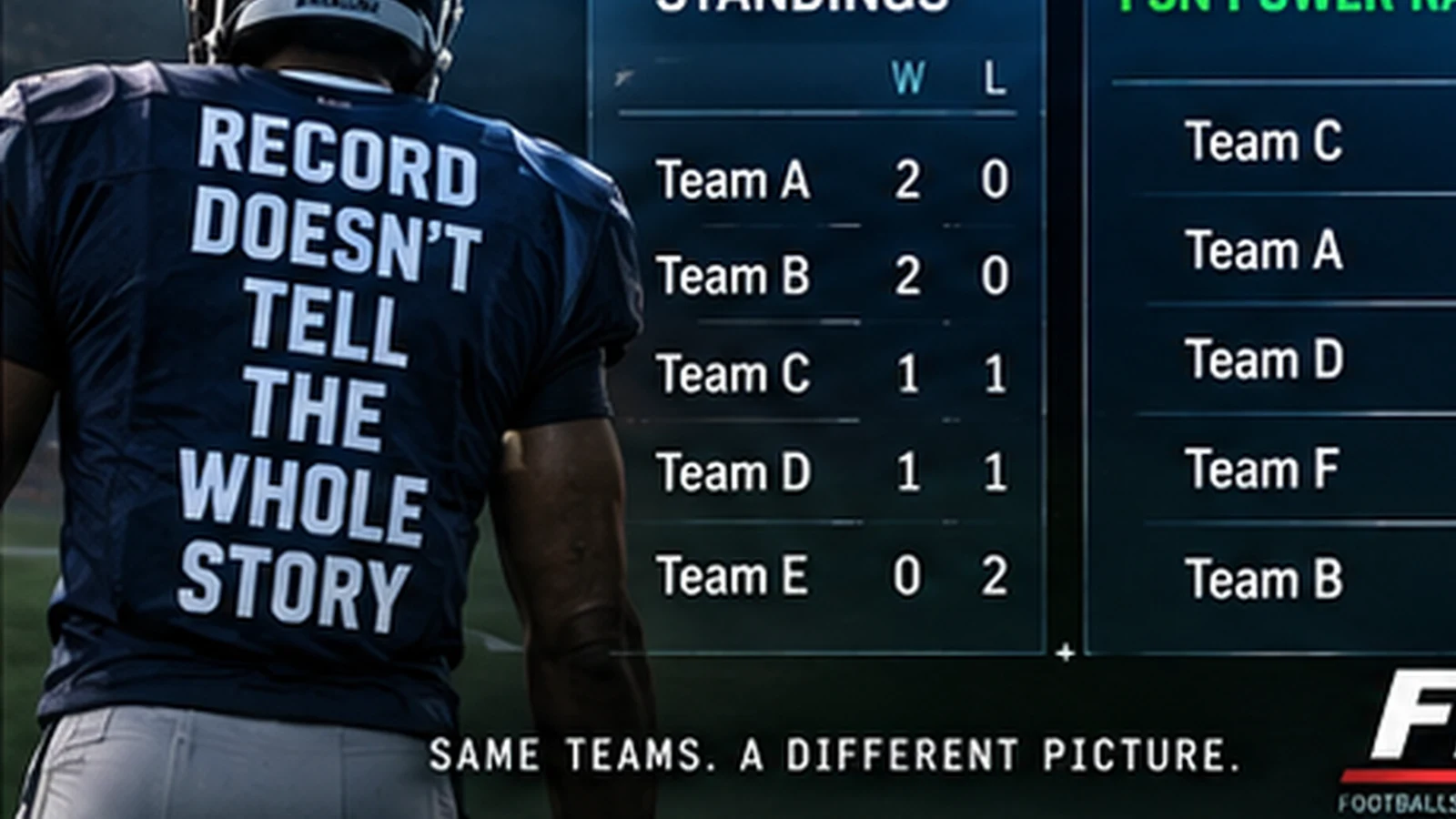
The NFL standings are brutally simple: wins on one side, losses on the other. FSN’s Power Ratings are trying to answer a different question entirely.
That difference is why the most useful Week 3 story is not who sits at 2-0 or 0-2. It is where the standings and the model are arguing with each other.
The scoreboard says one thing. The model says another.
The cleanest disagreement belongs to Houston and Las Vegas.
Houston is 0-2. If the standings were the only evidence available, the Texans would look like an early-season problem. FSN’s power model still places Houston 10th with a 63.4 rating, while the Week 3 season simulation projects 8.4 wins and gives the Texans a 40.1% playoff probability.
Las Vegas is the mirror image. The Raiders are 2-0, but FSN’s current power rating places them 25th at 28.7. The season simulation projects 7.6 wins and a 27.5% playoff chance.
One team has the worse record and the much stronger power profile. The other has already banked two wins but has not yet convinced the model that the underlying level of play is sustainable.
Case for the standings: Cincinnati and Philadelphia have already bought themselves room
Cincinnati and Philadelphia show why wins already in the bank matter even when the power model is less enthusiastic.
The Bengals are 2-0 and carry a 76.3% playoff probability with 10.4 projected wins. Yet FSN’s power rating puts Cincinnati only 17th at 47.2.
The Eagles are also 2-0. Their Week 3 simulation shows a 65.7% playoff probability and 9.8 projected wins, while the power board places Philadelphia 14th at 58.7.
The standings have already delivered something the power model cannot take away: two actual wins. That is why both teams can have strong playoff paths even though their underlying power ratings remain more cautious.
Case for the model: Jacksonville and Baltimore still look stronger than .500
Jacksonville is only 1-1, but FSN places the Jaguars third in the current Power Ratings at 90.8. The season simulation also remains bullish: 85.5% to make the playoffs, 71.9% to win the division and 10.7 projected wins.
Baltimore is another 1-1 team that the standings flatten into the middle. FSN ranks the Ravens fifth at 86.9, while the Week 3 simulator gives them a 75.6% playoff chance and 10.1 projected wins.
The model’s argument is not that their losses do not count. It is that one loss has not erased the opponent-adjusted efficiency and team-strength evidence underneath it.
The real disagreement is about what counts as signal
The standings treat every win as one win and every loss as one loss. That is exactly what they should do.
The power model asks whether the way a team has played is likely to repeat. Opponent quality, efficiency, résumé, recent form and uncertainty all matter.
The playoff simulator asks a third question: given the wins and losses already locked, what does the rest of the schedule look like from here?
Those systems should not always agree. If they did, one of them would be redundant.
Three records FSN thinks may be underselling the team
Houston at 0-2 is the loudest example. Jacksonville and Baltimore at 1-1 are the other two. All three rate substantially better in the FSN power model than their records alone would imply.
The case is strongest when both the power board and the season simulation point in the same direction. Jacksonville does that. Baltimore largely does too. Houston is more unsettled: the power rating still likes the Texans, while the playoff simulator is much more cautious because 0-2 creates real path damage.
Three records FSN is not ready to take at face value
Las Vegas at 2-0 is the sharpest example of a record the model is still questioning.
Cincinnati and Philadelphia require more nuance. FSN is not saying either team is bad. Their records are valuable and their playoff paths reflect that. The model is simply less convinced that their underlying performance belongs with the league’s elite teams right now.
Week 3 is the argument’s next round
If Houston keeps losing, a top-10 power position becomes harder to defend. If Las Vegas keeps winning while producing stronger opponent-adjusted efficiency, the power model should rise toward the standings. If Cincinnati and Philadelphia keep stacking wins while improving underneath them, their record and rating should begin converging.
This is exactly why FSN should publish the disagreement now. By December, records and power ratings often tell more similar stories. In September, the gaps are where the information is.
FSN takeaway: the standings tell us what happened. The Power Ratings tell us which records the model still wants to challenge. Through the current Week 3 checkpoint, Houston and Jacksonville look stronger than their records, while Las Vegas looks far less secure than 2-0 suggests.
Sources
FSN NFL Power Ratings: https://footballsportsnews.com/nfl/power-ratings/
FSN Week 3 Playoff Predictions: https://footballsportsnews.com/nfl/playoff-predictions/week-3-2026/