
















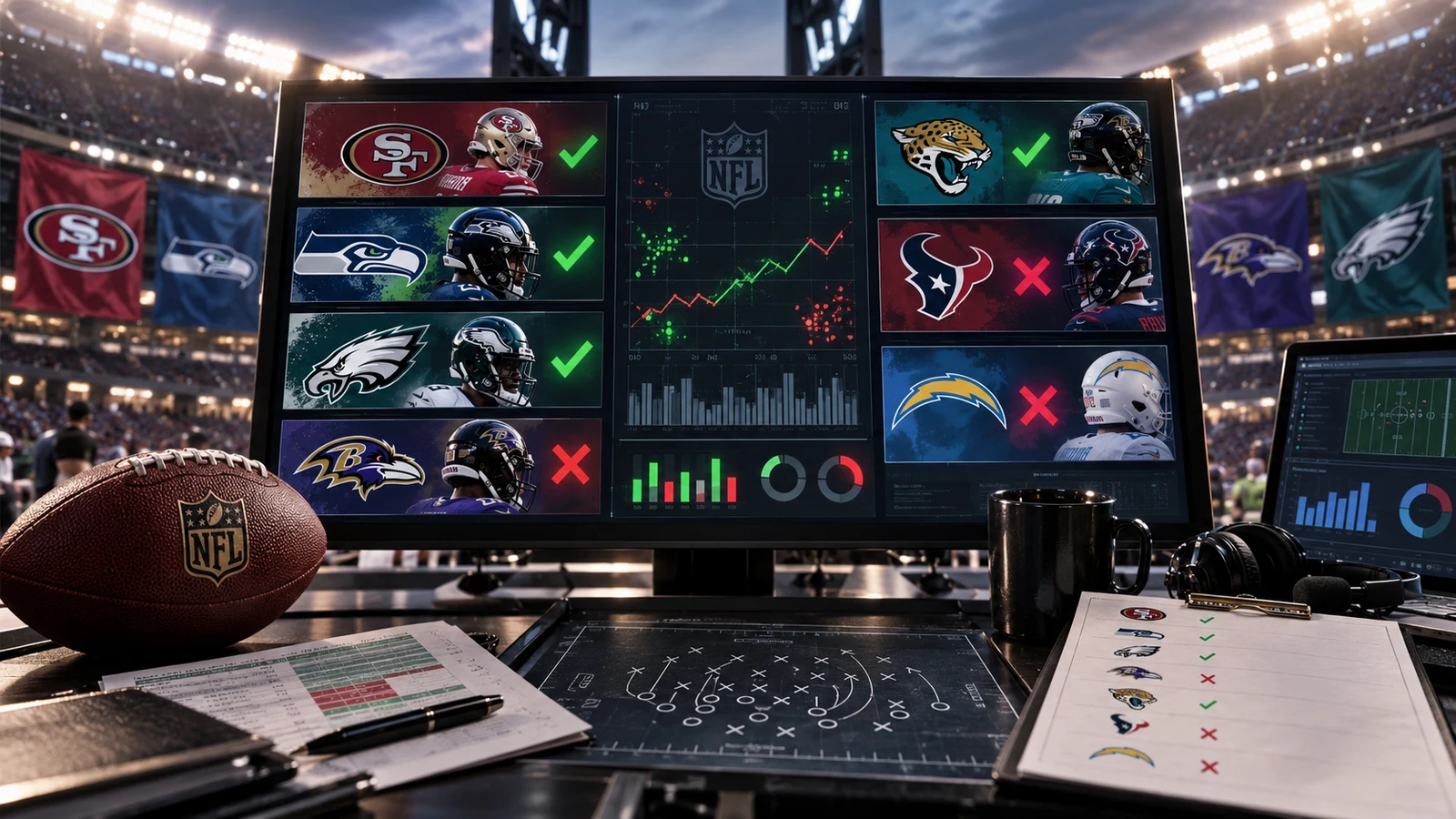
A prediction model should not get to erase Sunday on Monday morning.
That principle is built into the FSN Smart Game Simulator. Once a game kicks off, FSN preserves the final pregame snapshot rather than recalculating the old prediction with new information. That makes something possible that prediction sites often avoid: a real report card.
On the 15-game Sunday and Monday portion of Week 2, FSN’s stored straight-up favorites went 9-6, a 60% hit rate.
That is a winning record. It is also a useful warning about confidence. Several of the model’s strongest favorites lost outright.
The nine games FSN got right
The simulator correctly picked Carolina over Atlanta at 55%, New England over Pittsburgh at 73%, Green Bay over the Jets at 63%, Philadelphia over Tennessee at 82%, Seattle over Arizona at 81%, Dallas over Washington at 64%, San Francisco over Miami at 92%, Kansas City over Indianapolis at 67% and the Rams over the Giants at 69%.
Some were close for a reason. Carolina was only a 55% model favorite, yet won 34-3. Kansas City needed overtime to beat Indianapolis 33-30. Green Bay needed overtime to beat the Jets 20-17.
That variation is important. A probability is not a projected margin. A 55% favorite can win by 31, and a 67% favorite can need overtime. The model is estimating which side wins more often across thousands of plausible game states, not promising one exact script.
The 92% San Francisco call was the cleanest high-confidence hit
FSN’s strongest Sunday favorite was San Francisco at 92% against Miami. The 49ers won 35-13.
Brock Purdy completed 20 of 22 passes for 287 yards and two touchdowns and added a rushing score. San Francisco’s result aligned with the model’s strongest edge: the team expected to control the matchup did so.
Seattle’s 81% edge also held comfortably in a 31-7 win at Arizona. Philadelphia, listed at 82%, survived a much tighter 24-20 game in Tennessee.
The six misses were not small
FSN missed New Orleans over Baltimore, Minnesota over Chicago, Cincinnati over Houston, Cleveland over Tampa Bay, Denver over Jacksonville and Las Vegas over the Chargers.
More importantly, several were high-confidence misses. Baltimore was an 83% FSN favorite; New Orleans won 24-17. Jacksonville was a 79% favorite; Denver won 20-13. Houston was a 75% favorite; Cincinnati won 20-6. Tampa Bay was a 72% favorite; Cleveland won 23-19. Chicago was a 70% favorite; Minnesota won 9-3. The Chargers were a 68% favorite; Las Vegas won 26-14.
There is no useful way to dress that up. The model was on the wrong side of six games, and five of the six misses were favorites of 70% or higher.
Why high-confidence misses matter more than coin-flip misses
If a model goes 50-50 on games it labels 51%, nothing unusual has happened. If a model repeatedly loses games it labels 80% or 90%, that is a calibration problem worth investigating.
Week 2 therefore creates a more important question than the 9-6 record: were the largest edges too aggressive?
One week cannot answer that. It can tell FSN what to track.
The simulator starts with opponent-adjusted team strength, then layers current player production, quarterback form, injuries, EPA and CPOE, recent results, rest, venue, travel and matchup context. Market spread and total data, when available, are used only as a capped reality check. Early in the season, every one of those inputs has less current-year evidence than it will in October or November.
That is why September calibration matters so much. A model can be directionally sensible and still be too certain about the size of an edge.
Week 2’s most instructive miss: Baltimore 83%
Baltimore’s loss to New Orleans is the kind of result a transparent system should keep visible. The Ravens were one of the week’s strongest simulator favorites. The Saints won anyway.
That does not prove the 83% number was irrational. A true 83% favorite still loses 17 times in 100. What matters is whether FSN’s 80%-plus favorites, over a larger sample, win approximately as often as the model says they should.
The same logic applies to Jacksonville at 79% and Houston at 75%. Individual games are anecdotes. A preserved archive turns them into a calibration dataset.
Week 2 also exposed the danger of reading team identity instead of current evidence
Several misses involved teams that entered the week with strong prior expectations. Baltimore, Houston and the Chargers all lost to opponents the model rated lower. Early-season models inevitably carry some prior-season information because two weeks of football cannot replace an entire baseline overnight.
FSN’s methodology deliberately fades those priors as current-season evidence accumulates. Week 2 supplied exactly the kind of evidence that should accelerate that transition.
What 9-6 means and what it does not
A 60% straight-up week is respectable. It is not enough to claim predictive superiority. It is also not the right metric by itself.
FSN should be judged on at least three things: straight-up accuracy, calibration by probability band and whether the model’s highest-confidence edges outperform its lower-confidence ones over time.
If 80% favorites do not win materially more often than 60% favorites, the probabilities are not doing useful work even if the overall record looks good.
The point of a public report card
FSN’s advantage is not pretending to know every Sunday in advance. It is that the site now has a model ecosystem with saved checkpoints: game predictions feed season simulations, the Playoff Predictor preserves weekly forecasts and the Rooting Guide derives leverage from the same season trials.
That ecosystem becomes more valuable when it is audited publicly.
FSN takeaway: the Week 2 Smart Simulator went 9-6 on the Sunday and Monday slate. The 60% record was solid, but the six misses included too many heavy favorites to ignore. Preserve the misses, measure calibration and let the model earn trust over time.
Sources
FSN Smart NFL Game Simulator and stored Week 2 predictions: https://footballsportsnews.com/tools/nfl-game-simulator/
NFL.com Week 2 results: https://www.nfl.com/news/2026-nfl-season-week-2-what-we-learned-from-sunday-s-games
NFL Week 2 schedule and final scores: https://www.nfl.com/schedules/2026/by-week/week-2