
















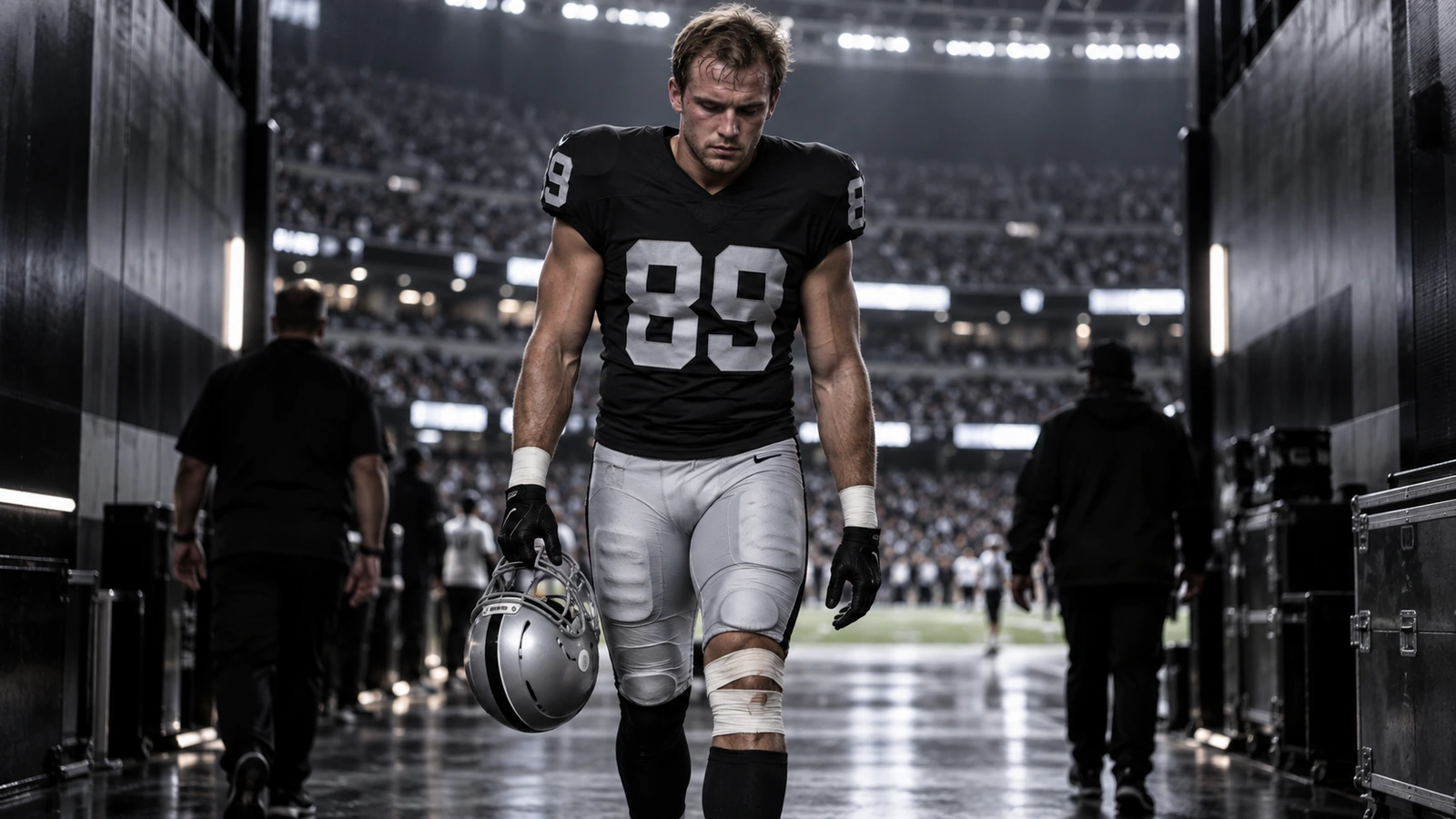
The Las Vegas Raiders will begin the 2026 season without the centerpiece of their passing game.
All-Pro tight end Brock Bowers underwent a meniscus trim Tuesday in Dallas and is expected to miss at least Sunday’s opener against the Miami Dolphins, according to reports from NFL Network and ESPN. The current expectation is that Bowers could miss a game or two after an injury that was suffered during training camp and diagnosed last week.
For the Raiders, that turns a late-week medical update into an immediate offensive problem. Bowers is not a complementary tight end whose snaps can simply be redistributed. He is the player defenses are most likely to build their coverage plan around.
The timing is the biggest problem for Las Vegas
Bowers’ procedure comes only days before the opener. That means the Raiders are not adjusting during the middle of a normal preparation cycle; they are changing the passing-game hierarchy at the moment the regular season begins.
The injury reportedly originated from a relatively minor camp issue, but the diagnosis ultimately led to the procedure. That explains why the news appeared abruptly after a preseason in which the Raiders had largely projected optimism about the health of the roster.
There is no indication that the team expects a lengthy absence at this point. Still, even a one- or two-game interruption matters because Las Vegas opens against Miami before facing the Chargers in Week 2.
Michael Mayer moves from useful depth to a central role
The Raiders’ Week 1 depth chart lists Michael Mayer directly behind Bowers, with Ian Thomas third. Mayer now becomes the obvious candidate to handle the largest share of traditional tight end work.
Mayer is not an unknown player. The 2023 second-round pick has already accumulated meaningful NFL snaps and has the size to remain involved as a blocker and intermediate target. What changes is the burden. When Bowers is available, Mayer can exploit matchups created by the attention directed toward the star. Without Bowers, Mayer becomes one of the players defenses can identify before the snap.
Las Vegas may also use more multi-receiver formations, but that solution is not automatic. The Raiders’ wide receiver room is relatively unproven behind the top options, making Bowers’ ability to create efficient targets in the middle of the field especially important.
Kirk Cousins loses his most dependable matchup piece
Quarterback Kirk Cousins was brought in to stabilize the offense, and Bowers was supposed to be one of the easiest players to feature early. Elite tight ends are valuable to veteran quarterbacks because they can create answers against man coverage, settle into zones and provide a large target when protection breaks down.
Without Bowers, Cousins may have to distribute the ball more evenly and rely more heavily on timing with receivers who do not have the same proven production. That could make the offense less predictable in one sense, but it also removes the player most capable of winning a matchup even when the defense knows where the ball might go.
The Raiders still have Ashton Jeanty to build around
The best way to survive a short Bowers absence may be to make the offense run through its other premium young playmaker. Running back Ashton Jeanty gives Las Vegas a legitimate foundation for a Week 1 game plan that does not require Cousins to throw 40 times.
A stronger run commitment can also help Mayer and the rest of the tight ends. Play-action becomes more dangerous when defenses have to respect the backfield, and linebackers can be manipulated into creating throwing windows that Bowers normally creates with his own route-running ability.
The challenge is that Miami now knows exactly where the Raiders’ most significant absence is. The Dolphins can devote more resources to stopping Jeanty and force Las Vegas to prove that its receivers can consistently win outside.
Bowers’ recent knee history makes the timeline worth watching
The Raiders will be careful because Bowers also dealt with knee trouble in 2025. That history does not mean the current procedure will produce the same result, and a meniscus trim has a wide range of recovery timelines depending on the specifics of the injury and the athlete.
What matters is that Las Vegas has little reason to force the issue in Week 1 if the medical staff believes a short absence can prevent a longer problem. Bowers is too important to the season to turn one September game into an unnecessary gamble.
The reported one- or two-game estimate should therefore be treated as an early expectation, not a guarantee. Practice participation next week will provide a more useful signal about whether the Chargers game is realistic.
What the Week 1 offense could look like
Expect Mayer to be on the field frequently, especially in early-down and play-action situations. Thomas can absorb additional tight end snaps, while receivers Tre Tucker, Jalen Nailor, Jack Bech and others may see more targets depending on personnel packages.
Las Vegas can also lean on motion and condensed formations to manufacture cleaner releases. Bowers often creates separation on his own. Without him, the coaching staff may need to create separation schematically.
The red zone is another area to watch. Bowers’ combination of size, body control and route feel gives the Raiders a natural answer when the field compresses. Mayer can fill some of that role, but Cousins may need to use backs and receivers more heavily near the goal line.
The bigger question is how quickly Bowers returns
A Week 1 absence is significant, but it does not need to become a season-defining event. If Bowers returns after one or two games at full strength, the Raiders will view this as an early inconvenience rather than a structural problem.
If the timeline stretches, however, Las Vegas will have to show that the offense can function without relying on its best pass catcher to solve coverage problems. That would place more pressure on Cousins, Jeanty, Mayer and a young receiving group.
For now, the immediate task is simple. The Raiders have to open the season without the player they expected to be their most difficult matchup. How well they adapt against Miami will offer the first real test of the depth and flexibility of the 2026 offense.