
















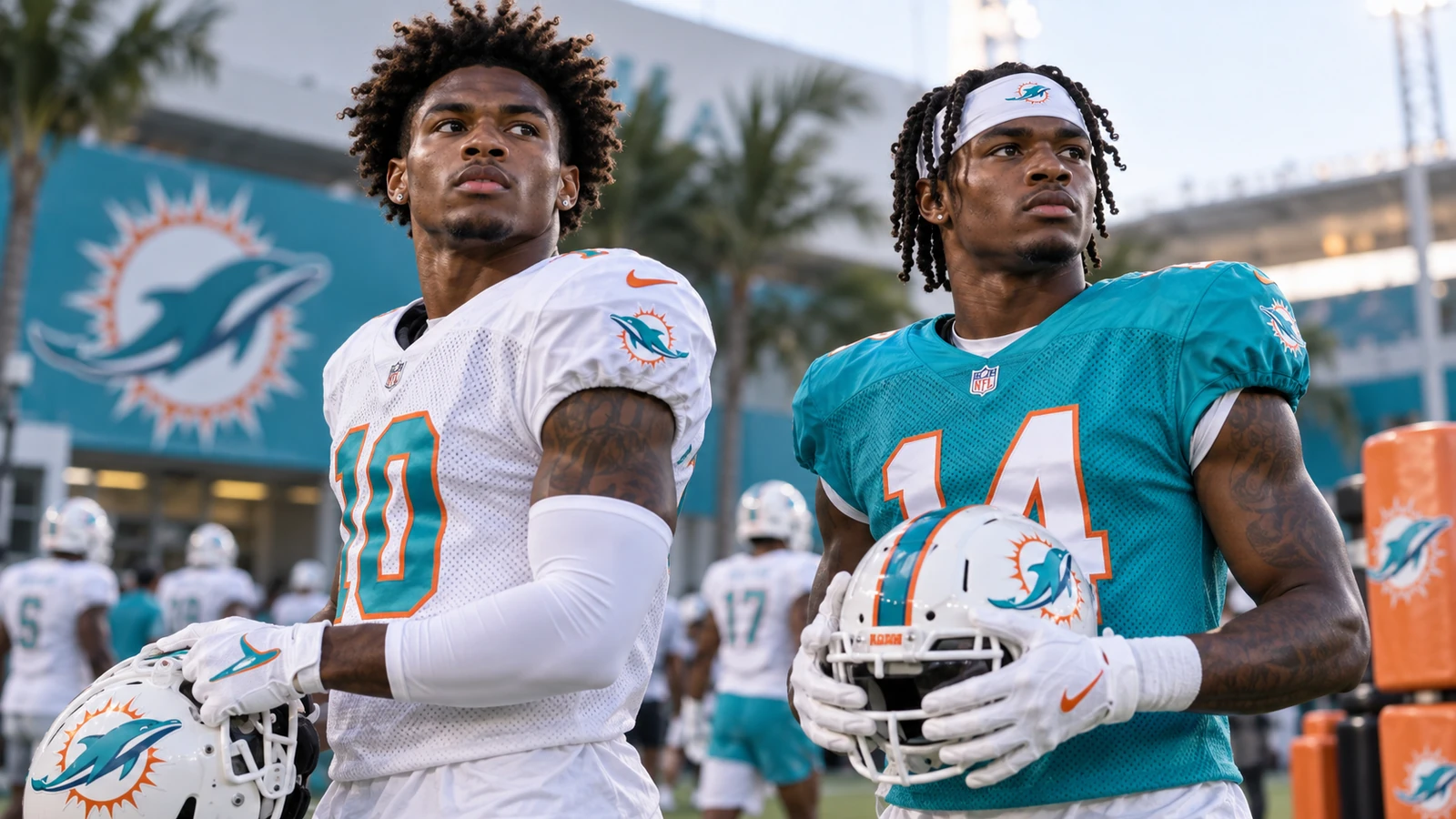
The Miami Dolphins are not easing their rookie receivers into the 2026 season. Their Week 1 depth chart lists Caleb Douglas and Chris Bell as starters alongside Malik Washington, and head coach Jeff Hafley has made clear that the decision is about merit rather than a ceremonial nod to a youth movement.
The most striking part is Bell. The third-round pick missed the offseason and much of training camp while recovering from the torn ACL he suffered late in his final season at Louisville. Yet Hafley said Wednesday that Bell will not enter the opener against the Las Vegas Raiders with a predetermined snap limit. Miami believes he has done enough to start and wants to evaluate the young receivers inside a winning game plan, not a developmental scrimmage.
Douglas, another third-round pick, is listed first at one outside receiver spot, while Bell is first at the other and Washington occupies the third starting position. Jalen Tolbert is behind Bell on the depth chart. The arrangement is one of the clearest signs yet that the Dolphins are willing to let the 2026 draft class define the offense sooner than many teams would.
This is more than a depth-chart curiosity
Unofficial depth charts can be misleading. Teams sometimes list veterans first out of convention, rotate players heavily in real games or use personnel groupings that make the posted order less important. Miami’s situation is different because Hafley has directly confirmed the intent to start both rookies.
That turns the story from paperwork into roster strategy. The Dolphins spent three draft picks on wide receivers in April, selecting Douglas 75th overall, Bell 94th and Kevin Coleman Jr. in the fifth round. It was the first time Miami had drafted three receivers in the same class since 1975. Four months later, two of them are already being placed at the front of the Week 1 offense.
The decision says Miami is not interested in protecting its young players from early mistakes if the coaching staff believes they have earned the work. That can accelerate development, but it also raises the standard. A rookie who starts is no longer being graded only on flashes. He has to line up correctly, convert routes against coverage, block when the ball goes elsewhere and earn the quarterback’s trust on third down.
Caleb Douglas gives Miami a different outside profile
Douglas arrived from Texas Tech with a 6-foot-3 frame and a track record of producing downfield. The Dolphins’ draft material notes that he led Texas Tech with 846 receiving yards and seven touchdowns in 2025 after a 877-yard season the year before. The attraction was not only size. Miami liked his ability to sink his hips and get out of breaks better than many tall receivers.
That matters for an offense now led by Malik Willis. A bigger outside target can provide a cleaner throwing window on intermediate routes and contested situations, particularly when the quarterback is moving outside the pocket. Douglas does not have to become a star immediately to be valuable. If he can force corners to respect his vertical range and consistently win the routes the offense asks him to run, he can make the field wider for everyone else.
Chris Bell’s rise is more surprising because of the ACL timeline
Bell’s starting designation carries a different kind of intrigue. Miami drafted him after a productive Louisville career that ended with a torn ACL late in 2025. The team’s draft profile lists 72 catches for 917 yards and six touchdowns in his final season and notes his first-team All-ACC selection.
He did not have a normal rookie offseason. Bell began camp behind the physical timeline of teammates who had spent months learning the offense at full speed. The Dolphins activated him in August, gradually increased his team work and watched him make enough progress to win a starting job anyway.
Hafley’s decision not to impose a snap cap is therefore meaningful. It suggests Miami is comfortable not only with Bell’s knee but with his conditioning and command of the offense. The opener will still be his first NFL regular-season game, so some unevenness would be normal. The team is simply refusing to pre-limit the opportunity.
The receiver decisions fit Miami’s broader 2026 reset
The Dolphins rebuilt the receiver room during the offseason after years in which the offense revolved around established veteran speed. The current depth chart looks younger, bigger and less proven. That creates volatility, but it also gives the organization a chance to discover which players belong in the next competitive version of the roster.
That is why the Douglas-Bell decision matters beyond Sunday. If both rookies prove they can handle starter-level work, Miami will have inexpensive young receivers under team control while it allocates resources elsewhere. If they struggle badly, the front office will learn early that the rebuild at the position still needs outside help.
Hafley has emphasized development as a major part of the season, but he pushed back on the idea that the Week 1 choices are simply about giving young players reps. His message was that the rookies earned the jobs and that winning remains the priority. That distinction is important. Development is most useful when players are forced to meet real standards rather than being guaranteed work regardless of performance.
What it means for Malik Willis
Willis enters the season as the starting quarterback on Miami’s depth chart, and his relationship with the rookie receivers will be one of the offense’s defining variables. Young wideouts can be difficult for quarterbacks because route timing, sight adjustments and scramble rules take time to become instinctive.
The upside is that the group can grow together. Douglas and Bell do not enter with years of habits built in another offense. If the connection works, Willis can establish the route preferences and trust that often become the foundation of a quarterback-receiver relationship.
The downside is obvious: Week 1 mistakes can become turnovers or missed explosives. Las Vegas will try to disguise coverage, challenge the rookies at the line and force them to prove they understand the details of the game plan. Miami’s willingness to start both players indicates the coaches believe they are ready for that test.
The Raiders game should reveal how real the depth chart is
The Raiders will not care that Douglas and Bell are rookies. They will test releases, force contested catches and make Miami prove it can stay on schedule without relying on veteran receivers to solve every difficult down.
Watch the third-down snaps and red-zone packages. Those are the situations in which coaches reveal trust. A receiver can technically start the game and still disappear when the offense reaches its most important plays. If Douglas and Bell remain on the field in those situations, Miami’s commitment will be far more meaningful than a depth-chart label.
What comes next for Miami’s rookie receivers
The opening month will probably include mistakes. That should not obscure the significance of what has already happened. Two third-round rookies have beaten out older options quickly enough that the Dolphins are willing to begin the season with both on the field.
For Douglas, Week 1 is a chance to turn a strong summer into regular-season credibility. For Bell, it is the culmination of an accelerated return from a major knee injury. For the Dolphins, it is the first public test of a roster-building bet: that a young receiver room can become an asset faster than expected.
If the rookies hold up, Miami may have found two long-term answers in one draft. If they do not, the team will at least learn that lesson early. Either way, the 2026 offense is beginning with a clear message. The Dolphins are not waiting for their young receivers to become part of the future. They are asking them to help define the present.