
















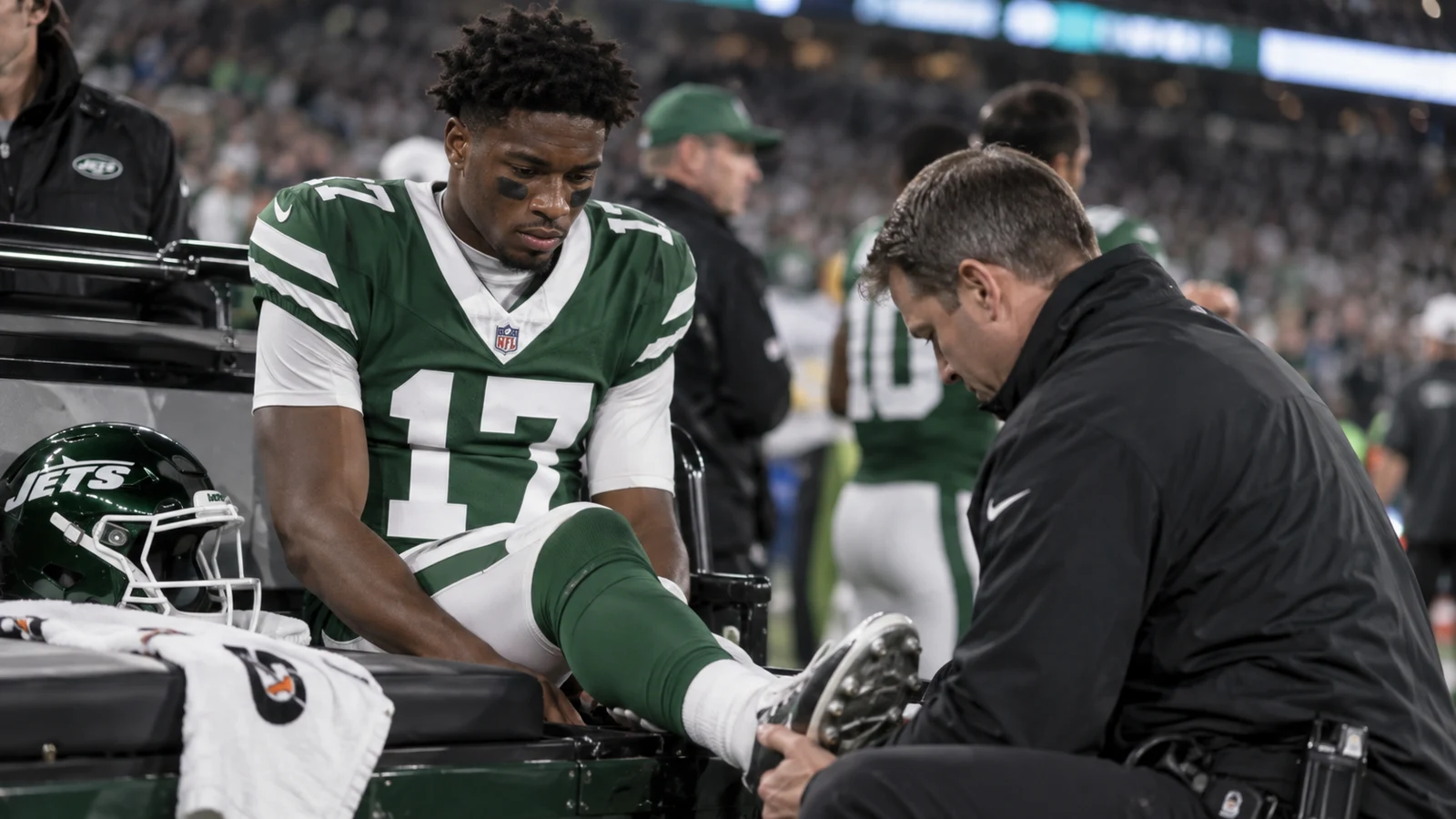

The New York Jets are expected to place rookie wide receiver Omar Cooper Jr. on injured reserve because of the ankle injury he suffered in the season opener, turning what had been a week-to-week absence into a minimum four-game shutdown.
NFL Network reported Saturday that Cooper will go on injured reserve and must miss at least four games before he can return. The encouraging part for New York is that the rookie is expected back not long after that minimum window, but the roster move still removes one of the Jets’ young receiving pieces from the immediate Week 2 plan and the next several games.
The development is a meaningful change from Friday, when Cooper had simply been ruled out against Green Bay after missing all three practices. FSN had already covered Cooper being unavailable for Week 2; the new information is that New York is now moving toward injured reserve rather than carrying him week to week on the active roster.
Omar Cooper’s injury now carries a four-game minimum absence
Cooper injured his ankle during New York’s Week 1 win over Tennessee. CBS Sports reported that the injury occurred on a 30-yard catch-and-run during the first half, on the first touch of his NFL career.
The Jets’ official Week 2 injury report showed Cooper as a non-participant Wednesday, Thursday and Friday before the team ruled him out against the Packers. Once he is placed on injured reserve, league rules require him to miss at least four games.
That means New York has to plan without Cooper not only for Week 2 against Green Bay, but also through a stretch that includes Detroit, Chicago and Cleveland before he can become eligible to return. Eligibility does not guarantee activation on the first possible date, but NFL Network reported that the current expectation is for Cooper to return relatively soon after the minimum absence.
The Jets lose a first-round rookie just as his role was beginning
Cooper entered the league as the No. 30 overall pick in the 2026 NFL Draft after New York traded back into the first round. The Jets spent that capital because they viewed him as a player capable of adding another dimension to a receiving group led by Garrett Wilson.
His regular-season debut was brief, but the 30-yard gain offered an early look at why New York was interested in his run-after-catch ability. The injury interrupted that momentum almost immediately.
For a rookie receiver, missing four or more games matters beyond the raw snap count. Cooper loses live-game repetitions with the offense, timing work with the quarterbacks and opportunities to grow into a larger route package. The Jets can keep him involved in meetings and rehabilitation, but the development that happens through Sunday snaps cannot be fully replicated.
New York will have to redistribute slot and secondary receiver snaps
With Cooper unavailable, the Jets will lean more heavily on their established receivers while finding additional snaps for the next layer of the depth chart. Garrett Wilson remains the clear focal point, while Adonai Mitchell and Isaiah Williams are positioned to absorb more of the work Cooper might otherwise have handled.
That does not mean the offense has to replace Cooper one-for-one. New York can compensate with more two-tight-end personnel, different receiver alignments or a heavier emphasis on its top targets. The larger question is how much flexibility the Jets lose without a rookie they drafted to become part of the long-term passing-game core.
The timing also matters because New York is already managing other Week 2 absences. Friday’s final injury report ruled out several players, including safety Minkah Fitzpatrick, which puts pressure on the roster as a whole rather than only the receiving room.
Why injured reserve makes roster sense for the Jets
If the medical expectation is that Cooper will miss multiple weeks regardless, injured reserve allows the Jets to use the active-roster spot elsewhere instead of carrying an unavailable player through several game days.
That flexibility can be particularly valuable early in the season, when teams are still adjusting the bottom of the 53-man roster and using practice-squad elevations to cover weekly needs. New York can add depth at another position now and revisit Cooper’s status once the return window becomes relevant.
The decision also creates a clearer timeline for the rookie. Rather than revisiting his game status every week, the Jets can focus on rehabilitation through the mandatory absence and then determine when he is ready for football activity.
What changed from earlier Jets injury coverage
Earlier in the week, the central question was how long Cooper’s ankle injury might keep him out and whether Week 2 was realistic. By Friday, the Packers game was off the table. Saturday’s injured-reserve report changes the story again: Cooper is no longer simply a one-week inactive, but a player New York expects to be unavailable through at least the next four games.
That is the important distinction for the Jets. The club is not merely adjusting one game plan. It is now preparing for a multi-week stretch without one of its 2026 first-round picks.
What to watch next
The next step is the corresponding roster move once Cooper is formally placed on injured reserve. New York could promote a player from the practice squad, sign outside help or use the open spot to reinforce another position affected by injury.
After that, the focus shifts to Cooper’s rehabilitation. The minimum four-game absence provides the earliest possible return point, but his actual activation will depend on how the ankle responds and when the Jets believe he is ready to resume full football work.
For now, the Jets have more certainty than they had earlier in the week. Cooper will miss more than the Packers game, and New York’s receiving rotation has to function without him for the next phase of the schedule.
Sources
- NFL.com: Jets expected to place Omar Cooper Jr. on injured reserve (September 19, 2026)
- New York Jets: Week 2 final injury report (September 18, 2026)
- CBS Sports: Cooper headed to injured reserve after Week 1 ankle injury (September 19, 2026)
- New York Jets: Cooper’s first-round draft context (September 9, 2026)